
Comparisons7-minute readFor civil service exam takers choosing how to review
Civil service exam review center or self review? An honest comparison
Weigh a civil service exam review center against self review: what each gives, who each suits, and the gap neither fills without timed papers.
You have decided to take the Career Service Examination, and now a practical question stands in the way: should you enrol in a civil service exam review center, or review on your own? Both are common, and neither is wrong. This post compares them by category, so you can match the choice to your time, your habits and your weak subjects.
CSE Exam Simulation, which publishes this blog, makes a practice simulator, which is a self-review tool. Weigh our views accordingly. We name no review centers and quote no prices, because both change, and the facts we rely on come from the Civil Service Commission (CSC) and are listed at the end.
What does the CSC say about review centers?
The CSC says it runs no review center and has accredited none. Its 2026 examination announcement states that the CSC "neither holds any review class nor publishes or distributes any review material", and that it does not accredit any individual, group or review center (CSC Examination Announcement No. 03, s. 2026).
Read that sentence carefully. It does not say review centers are bad. It says that no center, group or reviewer, including ours, carries the CSC's approval. A center may still teach well, and a lecturer may know the scope thoroughly. But nobody can honestly advertise a center as "CSC-recommended" or its handouts as the CSC's own.
The practical lesson is to judge any option by what it does for you. Ask what you will practise, how you will be timed, and how you will learn from mistakes. The CSC's wording tells you that the answer cannot be "because it is official".
What does a civil service exam review center give you?
A review center gives you structure, content delivered for you, and people around you. For many reviewees, those three things decide whether they study at all.
- A schedule. Sessions happen at fixed times, so the decision to study is made for you.
- Lectures and handouts. Someone organises the scope: General Information, Verbal Ability, Numerical Ability, and the Analytical or Clerical subtest for your level.
- A cohort. You see others preparing, which helps if you drift when alone.
- Accountability. Someone notices when you are absent.
The costs are also real. Fees vary and we do not quote them. Fixed schedules are hard for working applicants, and a lecture pace suits the class average, not you. Quality varies widely, and some centers lean on lectures when you need practice. If you choose a center, ask to see how often it runs full, timed, mixed papers and whether you get written explanations afterwards.
What does self review give you?
Self review gives you control over pace, order and cost. You decide when to study, which subtest to drill, and how long to stay on a topic that is not clicking.
That control matters for people with jobs, for repeat takers who know their weak subtest, and for anyone whose one free hour in the day is the commute. Self review can use a reviewer, flashcards, free compilations of past topics and a practice simulator. A self-paced reviewer can cover the scope in short lessons, and flashcards fit small pockets of time.
The weakness is discipline. Without a schedule, many self-reviewers read widely and test themselves rarely, then discover on exam day that they cannot hold their pace for a long mixed paper. They also tend to skip the subtest they like least. The CSC requires no review course, so self review is a fully legitimate route. We have no success figures for self-reviewers or for center students, and we do not invent any.
How do the two compare side by side?
The two routes differ most in structure and pace, and they are most alike in what they leave undone. This table compares the categories, not any named provider.
| Factor | Review center | Self review |
|---|---|---|
| Structure | Fixed sessions set by the center | You build it yourself |
| Cost | Varies by center | Varies by tools chosen |
| Pace | Set by the class | Set by you |
| Filipino Verbal practice | Depends on the instructor | Depends on your materials |
| Full timed papers | Only if the center runs them | Only if you sit them |
| Accountability | Built in through attendance | Needs a plan or a study partner |
The last two rows matter most. Verbal Ability is in English and Filipino, and the other subtests are in English, so check that whichever route you choose gives Filipino items real time. A review center may skip full papers, and a self-reviewer may skip them for lack of materials. In both cases, the gap is the same.
How can you vet a review center or a reviewer?
Vet a review center by what it can show you, not by what it promises. Ask five plain questions before you pay anything.
- How many full, timed, mixed papers will I sit, and when?
- Do I get a written explanation for every item I miss?
- How much of the Verbal Ability practice is in Filipino?
- Who writes the handouts, and when were they last checked against the current CSC announcement?
- What happens if my schedule changes?
Be wary of anyone who claims CSC approval, promises a pass, or says its materials contain the real questions. The CSC announcement says it accredits no review center, and it prohibits posting test questions online. A center that is open about those limits is easier to trust than one that hides them.
Who should choose which?
Choose a center if you need outside structure, and self review if you need flexibility. Your situation usually points the way.
- Fresh graduate with time. You may benefit from structure, because you are still in study mode and can attend regular sessions. If you prefer to study alone, a clear weekly plan does much of the same work.
- Working applicant. Self review tends to fit better. Evening classes are hard to sustain after full workdays, and short weekday blocks plus a weekend paper are easier. See reviewing while working.
- Repeat taker. You already know the exam. Self review aimed at the weak subtest is usually more efficient than repeating a general course, though a center can help if accountability was your problem.
If you are unsure, the 10-week layout in how to pass the civil service exam works with either route.
Can you combine both, and what gap remains?
You can combine both, and many people do: a center for structure, plus self-study tools for practice between sessions. The hybrid works best when you decide which part of the week each one covers.
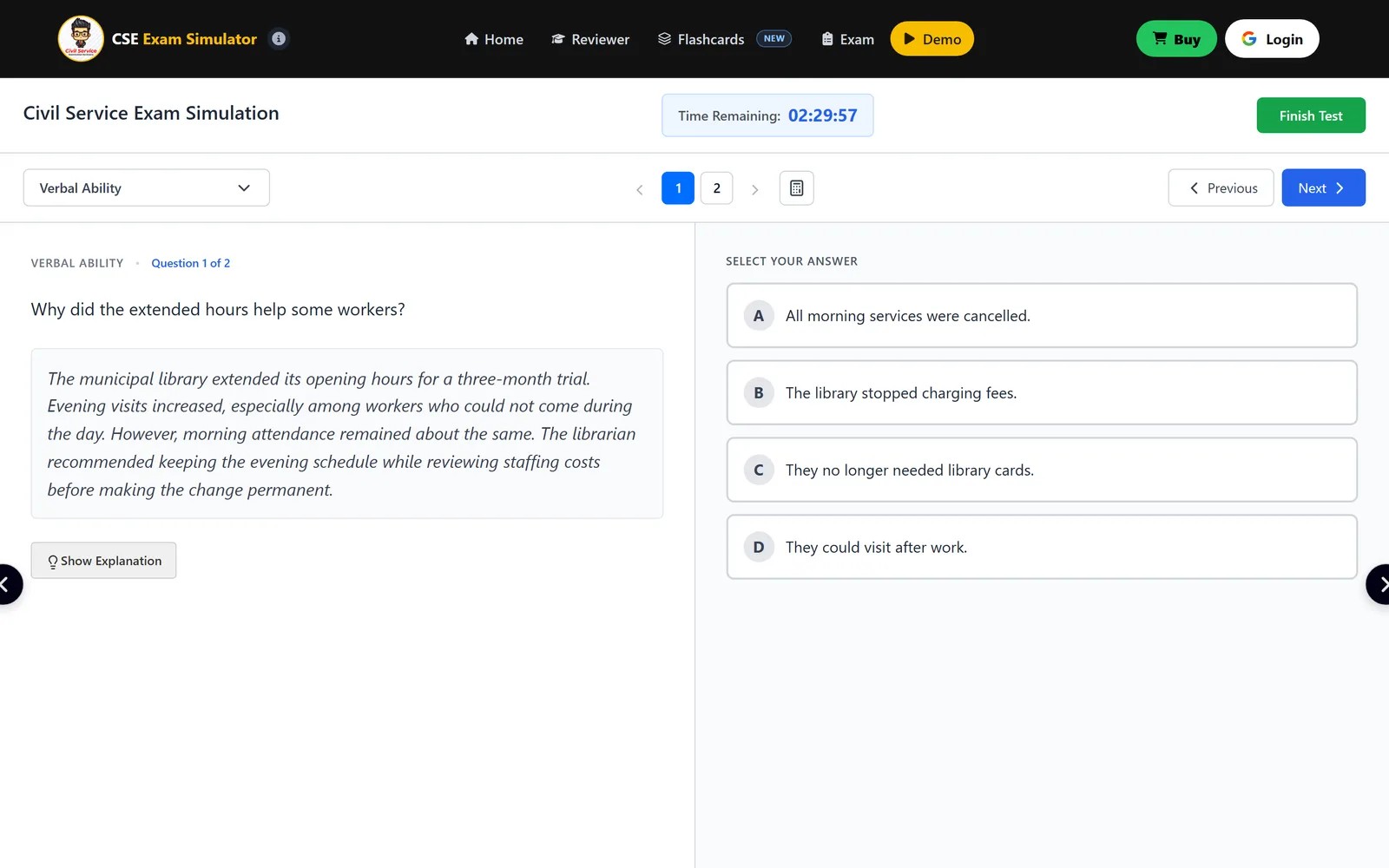
A hybrid plan might use sessions for content, a simulator for weekend full papers, and flashcards for gaps. Practice items from any source, ours included, are not CSC questions. The announcement prohibits photographing test materials and posting test questions online, so avoid anything claiming to hold the real paper.
When you compare options, our guide on how to choose a reviewer app offers nine concrete checks. To judge any tool yourself, try the free demo with its 10 items and no account.
Frequently asked questions
Is there an official CSC review center?
No. The CSC announcement says the CSC holds no review class and publishes no review material, and that it does not accredit any individual, group or review center. Any center or reviewer you choose is a private option, and none carries the CSC's endorsement.
Can you pass the civil service exam through self review?
The CSC does not require any review course, so self review is allowed. We have no success figures for self-reviewers or for center students and will not invent them. What counts is whether your plan includes timed mixed papers and a way to learn from every mistake.
When should I enrol if I choose a center?
Plan back from the application window, not from the exam date. The 2026 sittings were held on second Sundays, in March and August, and applications for the August sitting ran from 14 May to 10 June on a first come, first served basis (Daily Tribune). Applications can close early, so enrol with time to file.
Is a review center worth it for the civil service exam?
It is worth it if structure is what you lack and its schedule fits your life. It is not worth it if you would skip sessions or if it offers lectures without timed practice. Ask any center how many full papers it runs and how you review your answers.
Sources
- Examination Announcement No. 03, s. 2026: Conduct of CSE-PPT for Professional and Subprofessional Levels — Civil Service Commission
- How to apply for August 2026 Career Service Examination-Pen and Paper Test — GMA News
- CSC releases 2026 civil service exam schedule and application timelines — Daily Tribune
- CSE-PPT Results August 2026 — The Summit Express
From the publisher
Rehearse the mixed paper first.
CSE Exam Simulation is a practice simulator for the Career Service Examination, Professional and Subprofessional levels: full practice papers on a clock, with an answer and a short explanation for every item.
- 3,000 original practice items across both levels
- 15 practice papers per level, 160 items each, on a 2 hours 30 minutes timer
- An answer and a short explanation for every item
- A 12-chapter reviewer and 1,000 flashcards beside the question bank
Try the free CSE practice demo 10 practice items across all five subtests. No account needed.
About this article
Written by the editorial team that builds CSE Exam Simulation. Exam facts are checked against Civil Service Commission examination announcements and published CSC results, General Information facts against the 1987 Constitution and R.A. 6713, and every article lists its sources. How we write and check our articles.
First published .