
Study strategy7-minute readFor applicants planning a full review
How to pass the civil service exam: a 10-week plan built on full practice papers
How to pass the civil service exam with a 10-week plan: diagnose first, drill each subtest, rehearse full timed papers, then taper before the sitting.
Most people who ask how to pass the civil service exam are really asking for a schedule. They have a sitting date, a job or a thesis, and a pile of PDFs. What helps most is a plan that works backwards from the date and puts full timed papers in the middle, not at the end.
Here is a ten-week template, with hours as suggestions and every week tied to a measurable target. It assumes you start from zero. If you have already reviewed, skip ahead to the block you need. Dates and rules come from the Civil Service Commission (CSC), which runs the exam; the CSC does not publish review material, so a plan like this is yours to adapt.
How to pass the civil service exam: plan backwards from your sitting
Count ten weeks back from the exam date, and check the application window before you count. The CSC held its pen-and-paper test on 8 March and 9 August 2026, both second Sundays, according to the Daily Tribune's report of the calendar. For the 9 August sitting, the announcement set applications from 14 May to 10 June, first come, first served, and said they could close early.
As an example of the arithmetic: ten weeks before 9 August is 31 May, which falls inside that window. So file first, then start week 1. Waiting for the last day risks missing a closed window.
Write three dates on your wall: the start of week 3 (subtest blocks begin), the start of week 8 (full papers begin) and the exam day. If you have fewer than ten weeks, shorten each block and keep the order. If you have more, add a recall week in the middle rather than starting full papers early. See the schedule and exam-day guide for the rest of the calendar.
Why does the civil service exam need a deliberate plan?
The civil service exam needs a deliberate plan because most examinees do not pass it. A pass requires, in the CSC's words, "a general rating of at least 80.00". Published results show how that plays out: 34,719 of 240,934 examinees passed in August 2026, or 14.41% (Summit Express). In March 2026 it was 48,735 of 307,489, or 15.85% (PinoyTechSaga).
Roughly one in seven passed in the latest sitting. We make no claim about why the rate is what it is, and we have no figures for any group of reviewers. The practical reading is simple: a casual review leaves little margin.
Because the announcement states one general rating and does not publish how subtest scores combine, no subtest is safe to ignore. See what the 80.00 general rating means for the details, and passing rates by sitting for the numbers behind this section.
What do weeks 1 and 2 look like?
Weeks 1 and 2 are for diagnosis and rules: take a cold paper, read the exam-room rules and build an error log. Plan about eight to ten hours in each week; the hours are a suggestion and not a CSC figure.
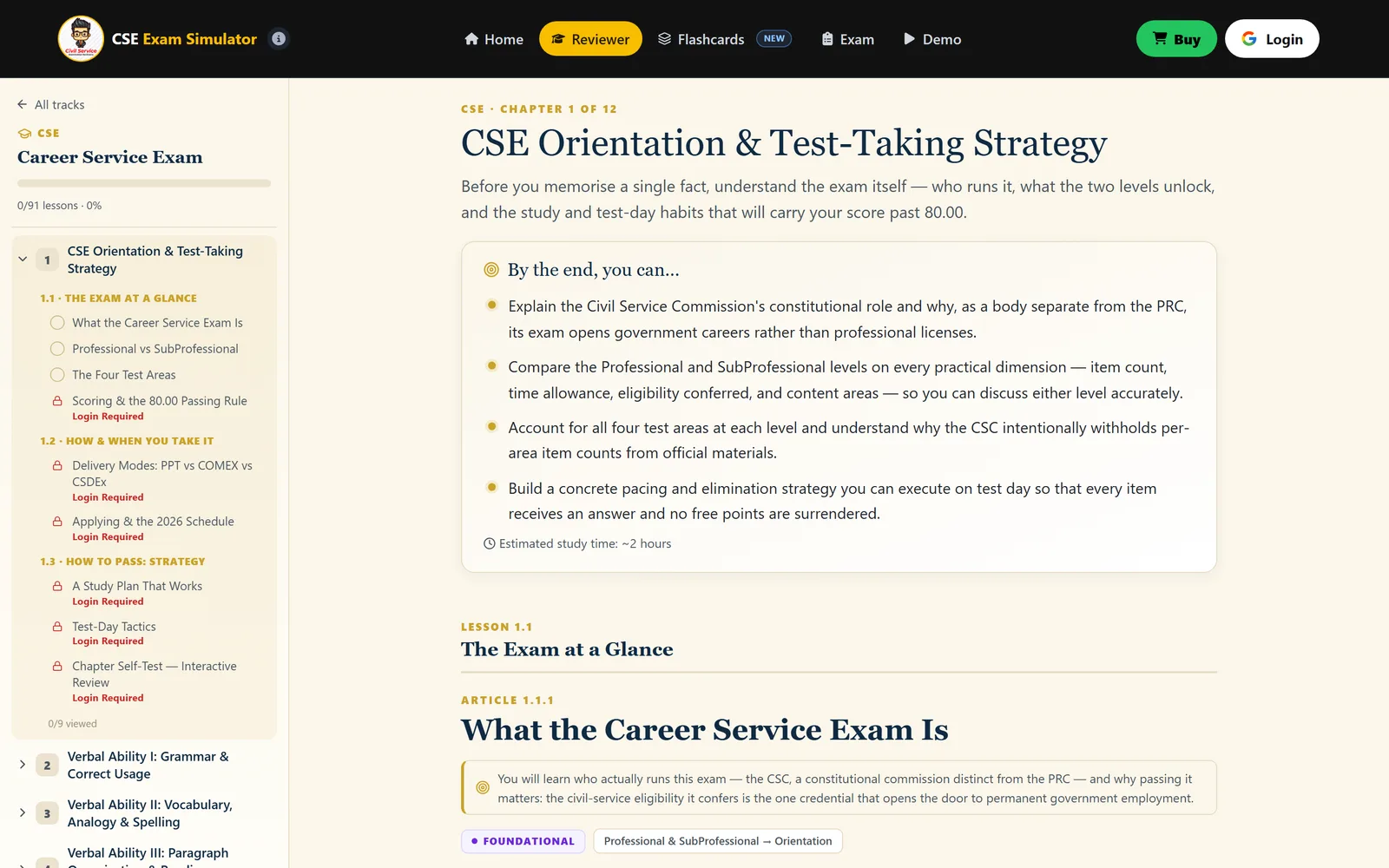
In week 1, try the free demo, then sit one full practice paper without preparing. The score matters less than the pattern, because the pattern tells you where to spend weeks 3 to 7. Read the room rules, including the ban on calculators, phones, printed material and scratch work on paper, skin or clothing, so that you practise the way you will sit. Read chapter 1 of the reviewer, which covers orientation and strategy.
In week 2, sort every miss by subtest and by cause: not knowing, misreading, arithmetic slip or time. Record them in one list. Choose your level's fourth subtest now, using Professional vs Subprofessional if you have not decided.
What happens in weeks 3 to 7?
Weeks 3 to 7 give each subtest its own block, with week 7 held back for repair. Plan about ten to twelve hours a week, and finish each week with a short timed set on that subtest.
| Week | Focus | Target |
|---|---|---|
| 1 | Cold paper, rules, demo | An error log started |
| 2 | Sort misses by cause | Weak subtests named |
| 3 | General Information | Constitution map and R.A. 6713 norms recalled |
| 4 | Verbal Ability | ng and nang, grammar checklist, paragraph order |
| 5 | Numerical Ability | Equivalents recalled; no-calculator methods |
| 6 | Analytical (Professional) or Clerical (Subprofessional) | Pattern types named on sight |
| 7 | Repair | Two weakest topics redone |
| 8 | Full timed papers, two | Each reviewed within a day |
| 9 | Full timed papers, two or three | Pace held to the clock |
| 10 | Taper | Light recall, logistics, sleep |
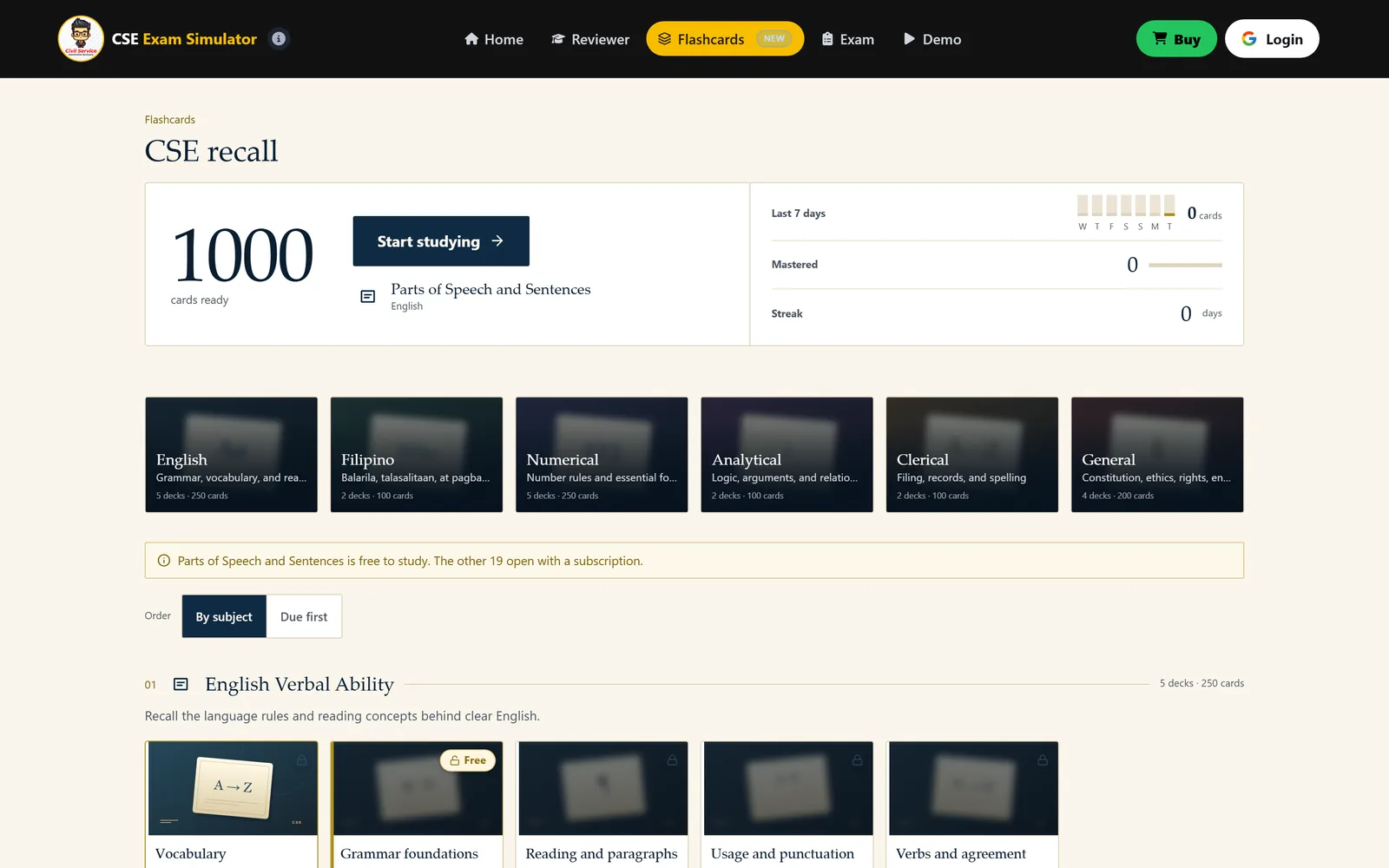
Each week has a guide: General Information, Verbal Ability, Numerical Ability and Analytical and Clerical. The flashcards fill the gaps between sessions.
What do weeks 8 and 9 look like?
Weeks 8 and 9 are for full timed papers, taken as if they counted. CSE Exam Simulation offers 15 practice papers per level of 160 items each, on a 2 hours 30 minutes timer, which is the product's own format and not the CSC's.
Sit two papers in week 8 and two or three in week 9, ideally at the hour of your real sitting and with a day between them. Use only what the exam room allows: no calculator, no phone, no notes.
Review each paper the next day. A paper takes 2 hours 30 minutes to sit, and a proper review takes about as long, because the learning is in the review. For every miss, write the cause in your error log: gap, misread, slip or time.
Watch your pace by subtest, not just overall. The time management guide shows how to set checkpoints. If one subtest keeps costing you points, give it extra short sessions rather than another full paper.
What do you do in week 10?
In week 10, taper: do light recall, sort out logistics and protect your sleep, with no new topics. Plan three or four short sessions of 30 to 45 minutes each, and finish them two days before the exam.
Spend the sessions on your error log and on the flashcards you keep missing. Check your documents, your route to the venue and your plan for what you will leave at home. The last-month guide covers the nerves and the final days.
Do not sit a full paper in the last two or three days. A bad score then does more harm than a good one does good, and the extra fatigue is not worth it.
What does a sample week look like?
A sample week mixes one long session, short daily blocks and a rest day. This is week 5 (Numerical Ability), assuming a weekday job and a free weekend; adjust it to your own hours.
| Day | Time | Task |
|---|---|---|
| Mon | 90 min | Fraction and percent equivalents; ten timed operations |
| Tue | 60 min | Number series checklist; twenty series |
| Wed | 60 min | Word problems: setup practice |
| Thu | 60 min | Mixed timed Numerical set |
| Fri | 30 min | Flashcards and error log |
| Sat | 3 hours | Timed Numerical set, then a mixed set of the other subtests |
| Sun | Rest | No study |
If you also work, the working reviewee schedule stretches the same logic across a full-time job.
Frequently asked questions
Is 10 weeks enough to review for the civil service exam?
It depends on where you start. Ten weeks is a workable frame for someone with a few hours a day, and it gives time for a diagnostic, five subject blocks and two weeks of full papers. We cannot promise a result, since the CSC publishes no data on how long examinees reviewed.
How many hours a day should I review?
Plan roughly ten to twelve hours a week in the subtest blocks, which is about 90 minutes a day with one lighter day. That figure is a suggestion, not a CSC requirement. Consistency across the ten weeks matters more than long single sessions.
When should I start full papers?
Start one cold paper in week 1 as a diagnostic, then return to full papers in weeks 8 and 9. In between, use short timed sets on single subtests. This keeps the early weeks focused on learning rather than on a score you cannot yet change.
Can I pass on my first take?
Some examinees do: 14.41% of examinees passed the August 2026 sitting, according to a secondary report of the results. We make no promise for you, and no claim about first-time takers specifically. A plan with full timed papers and honest review improves your preparation, not your odds on paper.
Sources
- Examination Announcement No. 03, s. 2026: Conduct of CSE-PPT for Professional and Subprofessional Levels — Civil Service Commission
- CSC releases 2026 civil service exam schedule and application timelines — Daily Tribune
- CSE-PPT RESULTS August 2026 — The Summit Express
- CSC announces March 2026 CSE-PPT results — PinoyTechSaga
From the publisher
Rehearse the mixed paper first.
CSE Exam Simulation is a practice simulator for the Career Service Examination, Professional and Subprofessional levels: full practice papers on a clock, with an answer and a short explanation for every item.
- 3,000 original practice items across both levels
- 15 practice papers per level, 160 items each, on a 2 hours 30 minutes timer
- An answer and a short explanation for every item
- A 12-chapter reviewer and 1,000 flashcards beside the question bank
Try the free CSE practice demo 10 practice items across all five subtests. No account needed.
About this article
Written by the editorial team that builds CSE Exam Simulation. Exam facts are checked against Civil Service Commission examination announcements and published CSC results, General Information facts against the 1987 Constitution and R.A. 6713, and every article lists its sources. How we write and check our articles.
First published .