
Comparisons7-minute readFor reviewees studying with ChatGPT
ChatGPT for civil service exam review: where a chatbot helps and where it misleads
ChatGPT for civil service exam review: where it helps with grammar and logic, where it misleads, and a safe workflow to follow.
Many reviewees now ask a chatbot to explain a topic or write practice questions. That is a reasonable thing to try, and this post is not an argument against it. ChatGPT for civil service exam review has real uses, and it has failure modes that matter more on this exam than on most.
CSE Exam Simulation, which publishes this blog, makes a practice simulator, so we have an interest in the comparison. We say nothing about how any chatbot works internally, and we make no claim about AI inside our product. Exam facts come from the Civil Service Commission (CSC) announcement, listed at the end.
Is ChatGPT for civil service exam review worth using?
The honest answer is that a chatbot can help you understand, but it cannot be trusted to be correct, and it cannot rehearse the exam. Use it for explanations you can verify, not for facts you cannot.
Think of a chatbot as a patient tutor who sometimes states wrong things with total confidence. For a grammar rule you can confirm in a reference, that is manageable. For an article number in the 1987 Constitution, a rule about retaking the exam, or a sum you will have to do without a calculator, it is a risk.
There is also a structural limit. A chatbot has no countdown, no fixed paper and no record of your timing. The CSE-PPT is a long mixed paper, and pacing is part of the skill. A chatbot can help you learn; it cannot make you sit a paper.
Where does a chatbot help?
A chatbot helps most where you need an explanation in plain words or more practice on a pattern. Five uses stand out.
- Grammar explanations. Ask why "its" fits one sentence and "it's" fits another, then ask for three more examples.
- Analogy and logic practice. Ask for word analogies and conditional-logic puzzles at your level, then review the reasoning it gives.
- Number-series practice. Ask for series and the pattern behind each, then verify the pattern yourself.
- Quizzing on material you have already read. Paste your own notes and ask for questions from them.
- English and Filipino vocabulary. Ask for word meanings, with example sentences, and check unusual words in a dictionary.
All five work because you can judge the output. You know the pattern or can look it up. The more a task depends on you trusting the chatbot's facts, the less suited it is.
In what five ways can it mislead you on the CSE?
A chatbot misleads in five ways that matter for this exam. None means you should avoid it; each means you should check.
- Confident wrong arithmetic. A chatbot can state a wrong sum fluently. The exam allows no calculator, so you cannot rely on a tool to catch it, and you must recompute by hand.
- Invented or misdated legal details. It may give an article or section number that does not exist, or attach the wrong year to a law. General Information rests on the Constitution and R.A. 6713, so check the text.
- Foreign civil-service framing. Ask about "the civil service exam" and the answer may drift toward another country's system, with different levels, formats or rules.
- Made-up CSC rules. The passing rule, the repeat rules and the prohibited items are in the CSC announcement. A chatbot may state its own version, including wrong waiting periods.
- Shaky Filipino grammar. Verbal Ability is in English and Filipino. Filipino rules such as the use of "nang" and "ng" are an area where chatbots can be inconsistent, so verify against a trusted reference.
Can a chatbot write your practice questions?
A chatbot can write practice questions, but you should treat them as drafts, not as a bank. Asking it for twenty analogy items or a handful of reading-comprehension passages is a fair use, and it is free variety on days when your materials feel stale.
The trouble is the answer key. A generated question can have two defensible answers, a keyed answer that is wrong, or a distractor that is accidentally correct. In a long series of generated items, a few such errors are likely, and you will not know which. A wrong key teaches you the wrong rule, and you may then defend it on exam day.
If you use generated questions, solve each one yourself before you read the chatbot's key, and doubt any disagreement. Where you and the chatbot differ, look the point up. That habit turns a flawed source into a useful one, because the effort of checking is itself good practice.
What do checked explanations offer that generated ones do not?
A checked explanation has been verified by a person and fixed in place, while a generated one is produced fresh and can differ each time. That difference matters most for facts you cannot easily verify.
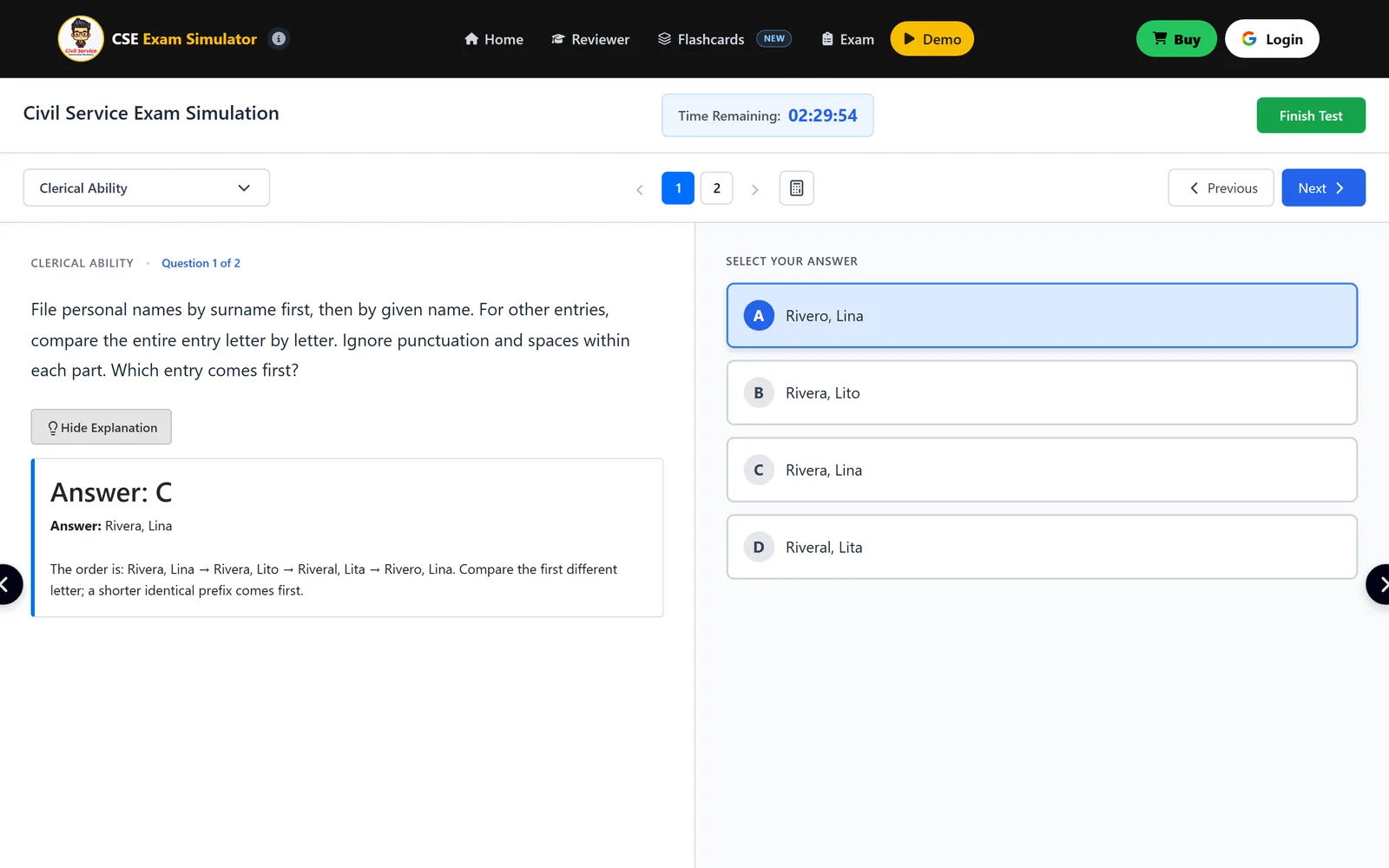
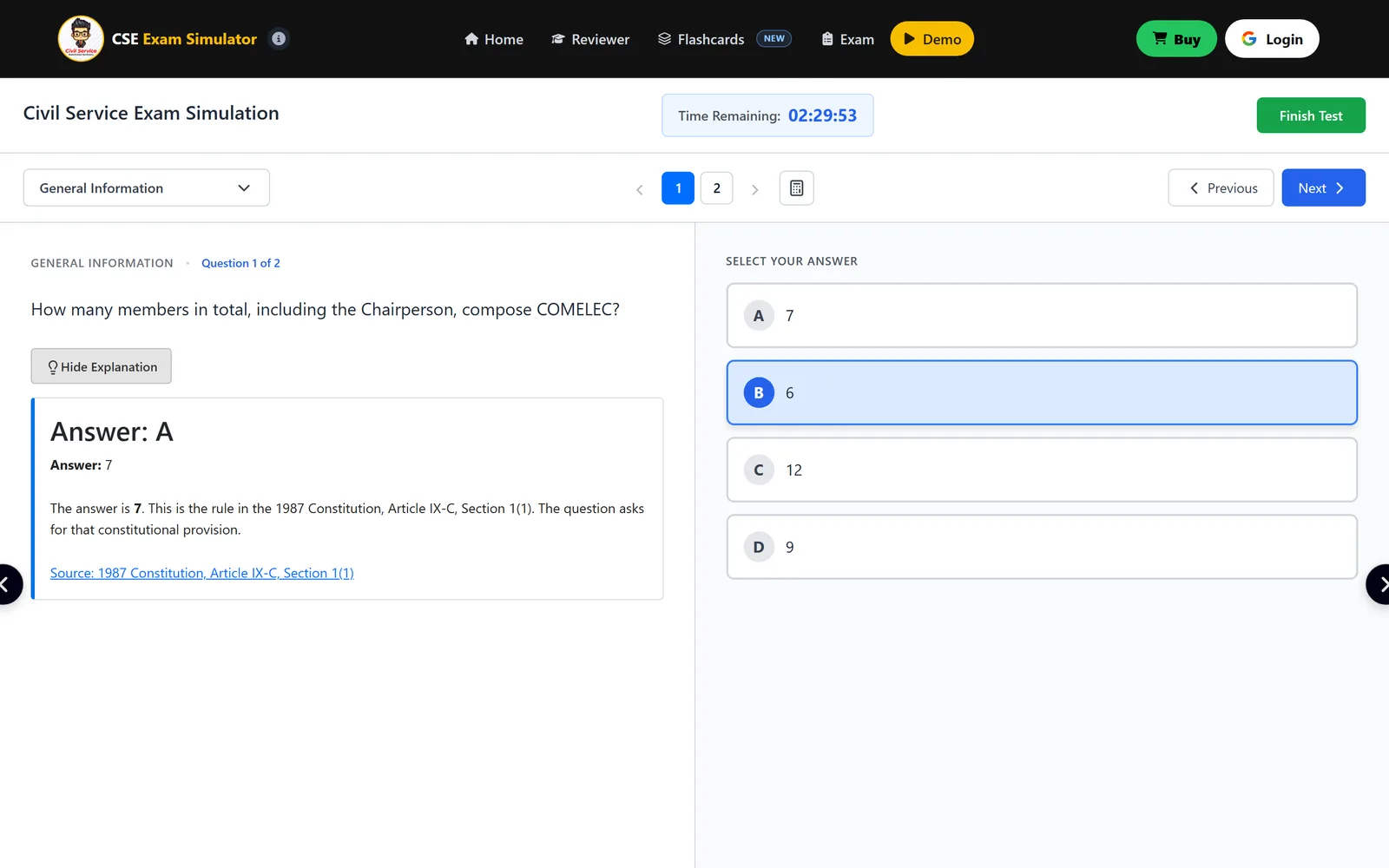
When a practice bank states "Answer: A, 7" and cites Article IX-C, Section 1(1) of the 1987 Constitution, you can go to the text and confirm it. The explanation is stable, so you will see the same one tomorrow. A chatbot may give a different answer to the same question next time, and a reviewee has no way to know which one was right.
Checked does not mean perfect. Our explanations are short, and we ask you to verify legal points against the primary text too. But a fixed, cited explanation gives you something to check. A fresh generation gives you a claim to trust. If you want to look at what we mean, the free demo has 10 items with explanations, and no account is needed.
How do a chatbot and a practice bank compare task by task?
The table matches common review tasks to the tool that suits them. Verdicts are general, not claims about any one product.
| Task | Chatbot | Curated practice bank | Verdict |
|---|---|---|---|
| Explaining a grammar rule | Good, if you verify | Short fixed explanation | Use both |
| Extra analogy or series practice | Good for variety, check the answers | Checked answers | Chatbot for volume, bank for trust |
| Arithmetic without a calculator | Can slip confidently | Worked answers | Use the bank |
| Constitution and R.A. 6713 details | Can invent or misdate | Cited sources | Use the bank, verify at the source |
| CSC rules (passing, repeats, prohibited items) | Can make them up | Not its job | Read the CSC announcement |
| Timed mixed papers | No clock or paper | Timer and fixed papers | Use the bank |
| Filipino Verbal items | Can be inconsistent | Items with explanations in Filipino | Use the bank, check grammar |
What is a safe workflow?
A safe workflow uses a chatbot for understanding and everything else for verification and timing. Follow these steps.
- Learn a topic from a primary or reviewed source. Use the chatbot to rephrase it, not to be the source.
- Check legal points against the text. For General Information, read the Constitution or R.A. 6713 itself.
- Check rules against the CSC announcement. The passing rule is "a general rating of at least 80.00". Do not accept a different number, and do not let a chatbot invent a waiting period.
- Recompute every sum by hand.
- Sit timed papers elsewhere. Use a curated bank with a clock, such as the practice papers in CSE Exam Simulation.
For the nine checks to apply to any practice tool, read how to choose a reviewer app. For the content a chatbot should be checked against, see the General Information guide.
Frequently asked questions
Can ChatGPT give me real CSE questions?
No, and you should not want it to. The CSC announcement prohibits photographing test materials and posting test questions online. A chatbot cannot know what is on a future paper. Anything it presents as a real or recalled question is invented, so treat it as a practice item at best.
Is a chatbot reliable on the 1987 Constitution?
Not on its own. It may explain concepts well, but it can invent or misdate details, including article and section numbers. Confirm every legal point against the text of the 1987 Constitution or the relevant law before you memorise it.
Is ChatGPT right about the passing score?
Check it against the CSC wording. The announcement says: "To pass the test, an examinee should get a general rating of at least 80.00." The CSC does not publish how subtest scores combine into the rating, so be careful with any chatbot explanation that turns it into a number of correct answers. Our passing score guide goes into it.
Sources
From the publisher
Rehearse the mixed paper first.
CSE Exam Simulation is a practice simulator for the Career Service Examination, Professional and Subprofessional levels: full practice papers on a clock, with an answer and a short explanation for every item.
- 3,000 original practice items across both levels
- 15 practice papers per level, 160 items each, on a 2 hours 30 minutes timer
- An answer and a short explanation for every item
- A 12-chapter reviewer and 1,000 flashcards beside the question bank
Try the free CSE practice demo 10 practice items across all five subtests. No account needed.
About this article
Written by the editorial team that builds CSE Exam Simulation. Exam facts are checked against Civil Service Commission examination announcements and published CSC results, General Information facts against the 1987 Constitution and R.A. 6713, and every article lists its sources. How we write and check our articles.
First published .