
The CSE explained7-minute readFor civil service exam takers
The civil service exam passing score: what a general rating of 80.00 does and doesn't tell you
The civil service exam passing score is a general rating of at least 80.00. See what the CSC states, what it leaves unpublished and how to set practice goals.
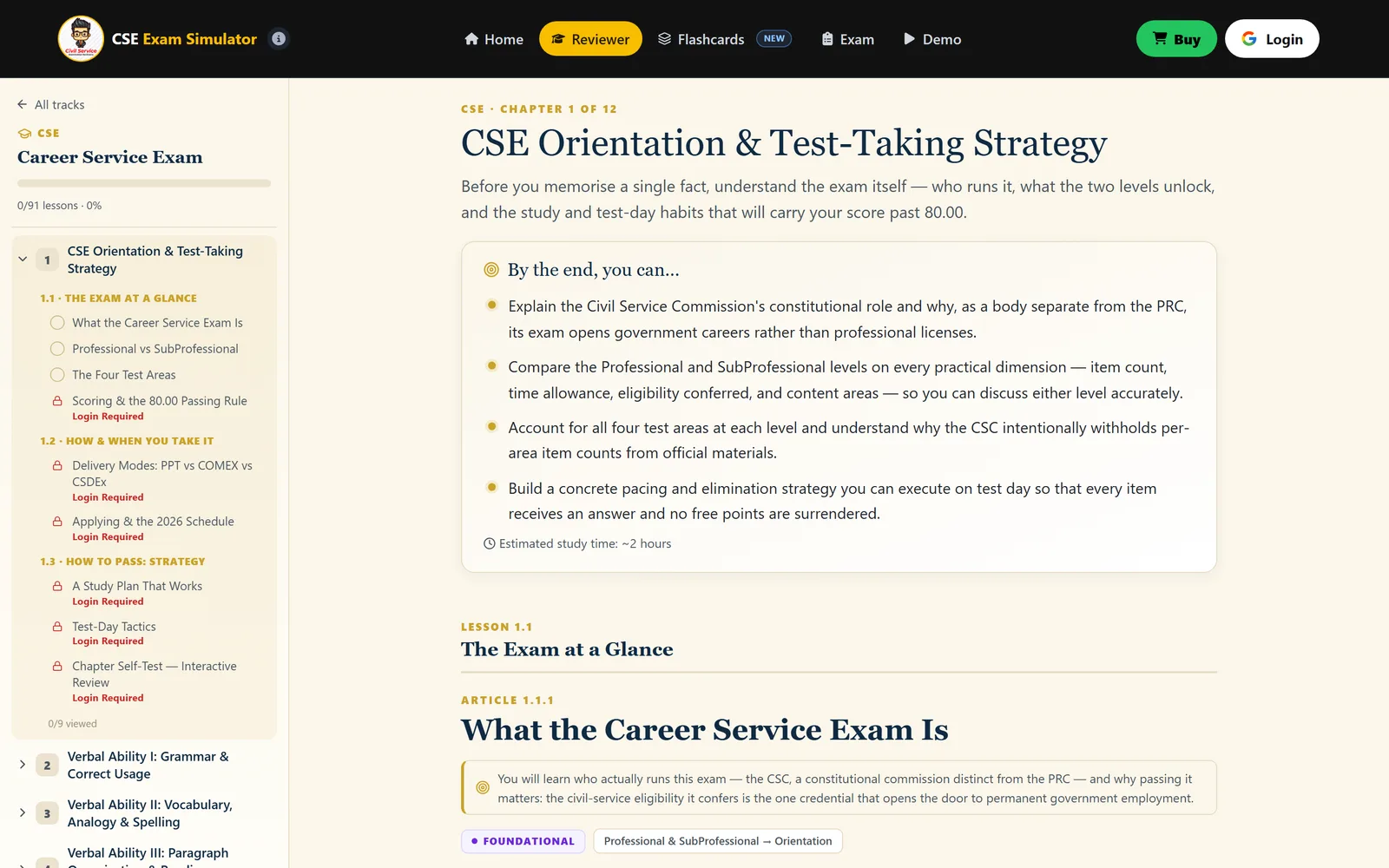
Reviewees often say the civil service exam passing score is 80%, and then ask how many items that means. The Civil Service Commission (CSC) never says that. It says an examinee must get a general rating of at least 80.00, and the difference between those two phrases is the whole point of this post.
Below we quote the rule, explain why "80%" shorthand misleads, list what the CSC does not publish, and show how to set practice goals without a conversion table. The CSC runs the Career Service Examination, Pen-and-Paper Test (CSE-PPT), and it is not the PRC, so the rules of other exams do not apply here.
What is the civil service exam passing score?
The passing score is a general rating of at least 80.00. CSC Examination Announcement No. 03, s. 2026 puts it this way: "To pass the test, an examinee should get a general rating of at least 80.00."
That sentence has three working parts. The measure is a general rating, so it is one overall figure rather than a list of subtest results. The bar is 80.00, written to two decimal places. And the words are "at least", so exactly 80.00 passes.
The announcement applies the same rule to the Professional and Subprofessional levels. Passing earns the matching eligibility: Career Service Professional Eligibility or Career Service SubProfessional Eligibility. For what each covers, see our Professional vs Subprofessional post.
Is a general rating of 80.00 the same as 80% correct?
No. A general rating is the CSC’s computed result, and the announcement does not say it equals the share of items you answered correctly. "80%" is a common shorthand, and it is the shorthand we use only to correct it.
The trouble is what people build on it. They take a guessed item count, multiply by 0.8 and then add a safety margin. That arithmetic assumes the rating is a plain percentage of correct answers, and the CSC has not said so. It also relies on an item count the announcement does not state.
If the rating involved a conversion or any weighting of subtests, a percentage-correct target could land too high or too low, and nothing published lets you check which. We neither confirm nor deny any weighting, because there is nothing to confirm against. The safe reading is to treat 80.00 as the CSC’s own scale.
What does the CSC not publish about the rating?
The announcement states the passing rule and stops. It does not publish how subtest scores combine into the general rating, how raw scores convert, or any weights. It also does not publish any breakdown of the paper by subtest.
| What you’ll hear | What the CSC announcement actually says | How to treat it |
|---|---|---|
| "You need 80% correct." | A general rating of at least 80.00. | Use the CSC’s wording. Do not turn it into a percentage of correct answers. |
| "You need X correct answers." | No count of correct answers is published. | Treat as a guess, whoever says it. |
| "Numerical counts double." | No weights are published. | Treat as unverified. We neither confirm nor deny any weighting. |
| "Pass each subtest at 80." | Only a general rating is stated. | Do not assume a separate minimum per subtest. |
| "This reviewer matches the official scoring." | The CSC publishes no review material and accredits no review center. | Ignore the claim. |
The last row comes from the same announcement, which says the CSC neither holds any review class nor publishes or distributes any review material. Any product, ours included, that claims to mirror the CSC’s scoring is claiming something the CSC has not made public.
Is there a minimum score per subtest?
The announcement states only a general rating. It describes no separate minimum for any subtest, and we do not claim there is none as a rule of law. We report what the document says and leave the rest open.
The practical consequence is clear without settling that question. Every subtest feeds one overall rating, so a weak subtest pulls the overall result down and you cannot write one off. A reviewee who ignores Numerical Ability because the paper has no calculator is gambling with the rating, since the announcement says nothing that would protect that choice.
The subtests are set out in the coverage post: General Information, Verbal Ability and Numerical Ability for both levels, plus Analytical Ability for Professional or Clerical Ability for Subprofessional. Plan to be sound in all four, and lean harder on the one where practice scores run lowest.
How does the passing score differ from the passing rate?
The passing score is the bar you must clear. The passing rate is the share of all examinees who cleared it in a sitting. They answer different questions, and mixing them up produces bad advice.
The CSC’s bar stays at a general rating of at least 80.00. The share who reach it has been well below half. For the 9 August 2026 sitting, a results report gives 34,719 passers out of 240,934 examinees, which is 14.41%. For 8 March 2026, another report gives 48,735 of 307,489, or 15.85%. For August 2025, as reported, the figure is 50,096 of 331,675, or 15.10%.
Those figures say how many cleared the bar. They do not say how hard the bar is for any one person. Our passing rate post covers the numbers by level and sitting, and makes no claim about why the rates are what they are.
Where do you see your rating?
Examinees generate individual ratings through OCSERGS. The announcement set the target for the 9 August 2026 sitting as on or before 19 October 2026, after the List of Passers was posted. The CSC adds that only the List of Passers posted on the CSC website is official.
So there are two separate checks. The List of Passers tells you whether you passed. OCSERGS gives you your own rating. If you did not pass, that rating is the starting point for planning, and the retake guide takes you through the next steps and the three-month rule.
Be careful with copies of the list on social media or blogs. They can contain errors, and the announcement is explicit that the CSC website’s list is the official one. When you quote anyone’s result, quote it from there.
How can you set practice targets without a conversion table?
Set targets that you can measure yourself, and treat them as training signals. A practice score is the share of items you got right on a practice paper. It is not a CSC rating, and it will not tell you your eventual general rating.
Three targets work without any conversion.
- Raise the floor. Find your weakest subtest on a practice paper and aim to lift it before you polish your strongest.
- Close the gap. Narrow the spread between your best and worst subtest over three or four papers.
- Trend, not a single result. Judge yourself on the direction across several full papers, taken on a clock.
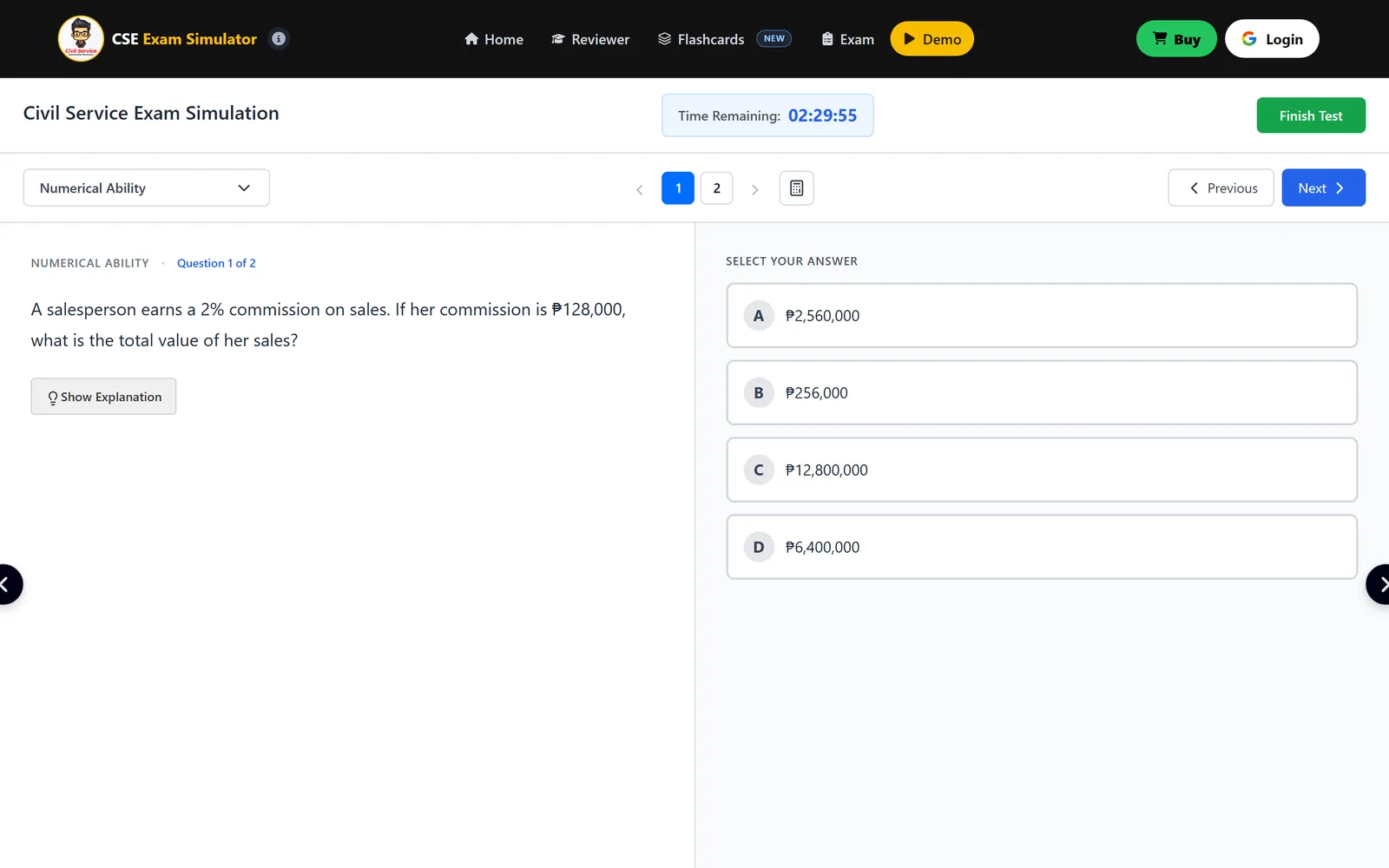
CSE Exam Simulation has 15 practice papers per level, each with 160 items, so you can track a trend across many sittings. Our items are original practice questions, and nothing in them is a CSC question or rating. You can try the free demo first, and read the time management guide for pacing.
Frequently asked questions
Is the civil service exam passing score 80%?
The CSC’s wording is a general rating of at least 80.00. People shorten that to 80%, but the announcement does not say the rating is the percentage of items answered correctly. Use the CSC’s phrase when you plan, and do not convert it into a number of correct items.
How many correct answers do I need to pass?
The CSC does not publish that number. It states the rule as a general rating of at least 80.00 and does not describe how raw scores convert. Any figure you see for correct answers needed is an estimate by whoever wrote it, not a CSC statement.
Do I need 80 in every subtest?
The announcement states only a general rating. It does not describe a separate minimum for each subtest. Because every subtest feeds one overall rating, you should still prepare for all of them rather than rely on strength in one.
Where do I see my rating?
Examinees generate their individual ratings through OCSERGS. The List of Passers is posted on the CSC website, and only that list is official. Check the list for your pass or fail status and OCSERGS for your own rating.
Sources
- Examination Announcement No. 03, s. 2026: Conduct of CSE-PPT for Professional and Subprofessional Levels — Civil Service Commission
- CSE-PPT RESULTS August 2026 — The Summit Express
- CSC announces March 2026 CSE-PPT results — PinoyTechSaga
- Over 50,000 pass August 2025 career service exam — Philippine Daily Inquirer
From the publisher
Rehearse the mixed paper first.
CSE Exam Simulation is a practice simulator for the Career Service Examination, Professional and Subprofessional levels: full practice papers on a clock, with an answer and a short explanation for every item.
- 3,000 original practice items across both levels
- 15 practice papers per level, 160 items each, on a 2 hours 30 minutes timer
- An answer and a short explanation for every item
- A 12-chapter reviewer and 1,000 flashcards beside the question bank
Try the free CSE practice demo 10 practice items across all five subtests. No account needed.
About this article
Written by the editorial team that builds CSE Exam Simulation. Exam facts are checked against Civil Service Commission examination announcements and published CSC results, General Information facts against the 1987 Constitution and R.A. 6713, and every article lists its sources. How we write and check our articles.
First published .