
Guides7-minute readFor reviewees facing the General Information subtest
Civil service exam general information: the Constitution, R.A. 6713, peace and human rights, and the environment
A study guide to civil service exam general information: the Constitution, R.A. 6713, peace and human rights, and the environment, with drills.
General Information is the subtest where reviewees either over-study or under-study. Some try to memorise the whole Constitution. Others assume common sense will carry them. Civil service exam general information is neither: it is four named areas, and each rewards a different way of studying.
This guide gives you a method for each area, plus a few facts we are certain of. We name an article or section only where we are sure of it, and where we are not, we describe without numbers. For exact text, use the primary source, which is why we point to the CSC announcement for the scope itself.
What does civil service exam general information cover?
The Civil Service Commission's Examination Announcement No. 03, s. 2026 lists four areas for General Information: the Philippine Constitution; the Code of Conduct and Ethical Standards for Public Officials and Employees (R.A. 6713); Peace and Human Rights Issues and Concepts; and Environment Management and Protection. The subtest is in English and is the same at both levels.
The announcement gives no weights for the four areas, so a plan that spreads time across all four is safer than betting on one. Because the announcement states one general rating, a weak General Information result still counts; see what the 80.00 general rating means. The coverage guide shows where this subtest sits among the five.
| Area | What to master | How to drill |
|---|---|---|
| Philippine Constitution | The structure, the branches, the rights, the constitutional bodies | Make a one-page map; quiz yourself by article title |
| R.A. 6713 | The norms of conduct and the duties of public servants | Learn the norms as a list; practise on scenarios |
| Peace and human rights | Definitions, key instruments, the bodies that protect rights | Concept cards; compare similar terms |
| Environment | State policy, main laws, core concepts | Match law to purpose; define terms in your own words |
How do you study the Philippine Constitution by structure?
Study the 1987 Constitution as a set of articles with a purpose each, not as a continuous text. You are far more likely to be asked "which part deals with this?" or "what does this body do?" than to be asked for a clause word for word, though we cannot promise how items are written.
Start with a one-page map of the articles. The Bill of Rights is Article III. The three branches follow: legislative (Article VI), executive (Article VII) and judicial (Article VIII). Article IX holds the constitutional commissions, including the Civil Service Commission, the Commission on Elections and the Commission on Audit. Article XI covers the accountability of public officers and states that public office is a public trust. Article XIII covers social justice and human rights.
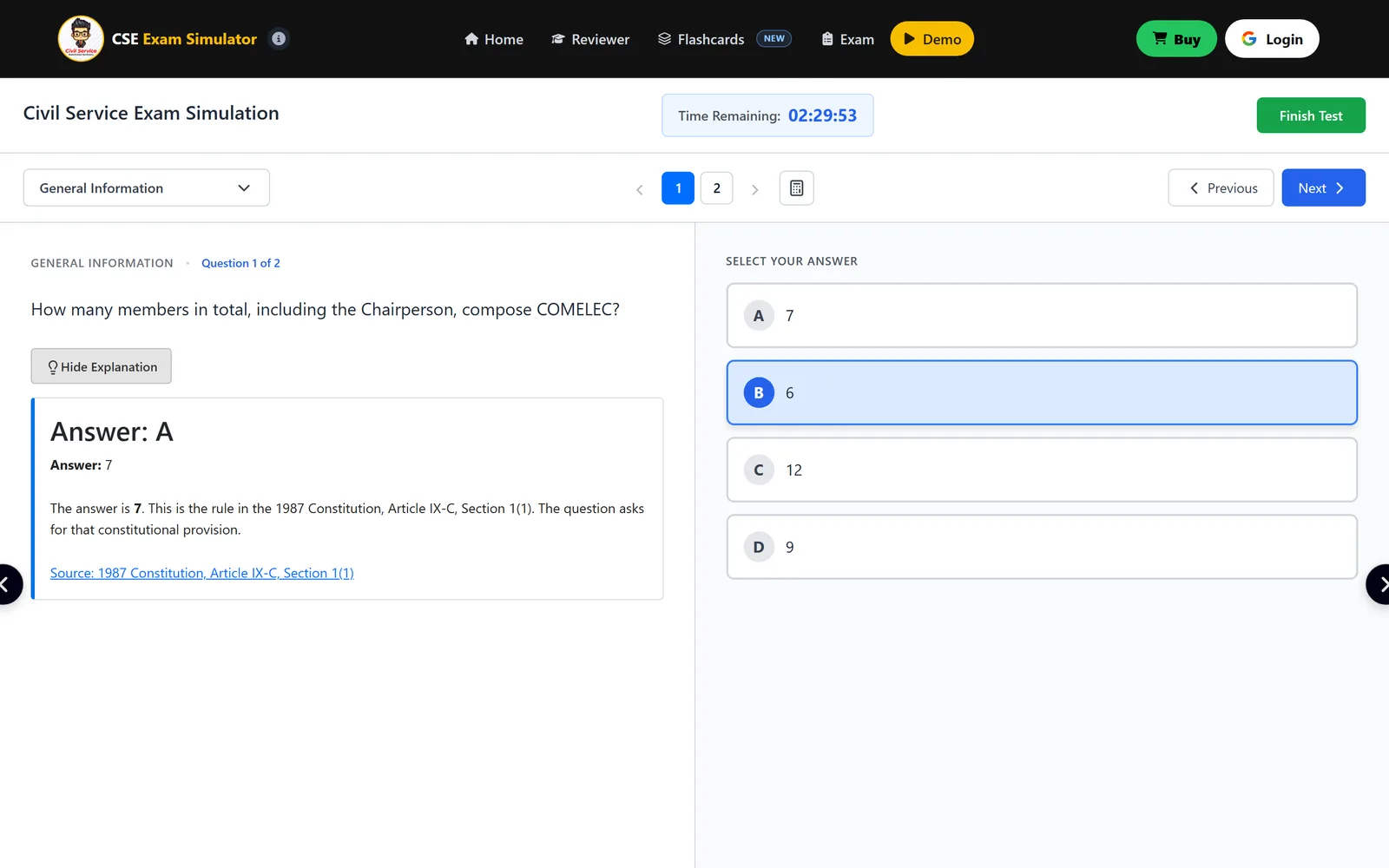
Then add small, certain facts to each box. The President serves a single six-year term. Senators serve six-year terms, with no more than two consecutive terms. The COMELEC is composed of a Chairperson and six Commissioners, seven members in all, as the demo item above shows.
What should you learn from R.A. 6713?
Learn R.A. 6713 as the code that describes how you will be expected to act once you are in government. Its full title, as the CSC announcement gives it, is the Code of Conduct and Ethical Standards for Public Officials and Employees. If you are aiming for a government post, it describes standards that will apply to you, so reading it is useful beyond the exam.
Memorise the norms of conduct as a list of eight: commitment to public interest, professionalism, justness and sincerity, political neutrality, responsiveness to the public, nationalism and patriotism, commitment to democracy, and simple living. A good mnemonic is to make one sentence per norm that describes a behaviour, such as "I answer a citizen's request on time" for responsiveness.
Then learn the code's duties and prohibitions in general terms: disclosure of assets, liabilities and net worth, avoiding conflicts of interest, and not soliciting or accepting gifts in connection with your official duties. We give no section numbers here. Practise on scenarios, such as a clerk offered a gift by an applicant whose papers she is processing: the safe answer is to decline.
How do you study peace and human rights concepts?
Study peace and human rights as a vocabulary of paired concepts, and learn to tell near-synonyms apart. The CSC lists the area as "issues and concepts", which points to understanding more than to citations.
Build cards on these points. Peace can mean the absence of armed conflict, or a broader condition in which people's basic needs and rights are secured. Human rights are commonly described as universal, inalienable and indivisible. The Universal Declaration of Human Rights was adopted by the United Nations General Assembly in 1948. The four Geneva Conventions of 1949 protect people in armed conflict. In the Philippines, the 1987 Constitution establishes the Commission on Human Rights.
Add a "who protects what" card for each right you learn. Compare civil and political rights with economic, social and cultural rights, and write one example of each.
How do you study environment management and protection?
Study environment management by linking each law to its purpose and by defining the core concepts in your own words. The 1987 Constitution's Declaration of Principles includes a state policy on the people's right to a balanced and healthful ecology, so the idea has constitutional roots.
Learn the lead agency, the Department of Environment and Natural Resources (DENR). Then match a few major laws to what they govern: the Ecological Solid Waste Management Act (R.A. 9003) for waste, the Philippine Clean Air Act (R.A. 8749) for air quality, and the Philippine Clean Water Act (R.A. 9275) for water quality. Check any other number you meet against the law's text before you rely on it.
Concepts worth a card each: sustainable development, the reduce-reuse-recycle idea, biodiversity, and the difference between climate change mitigation (cutting emissions) and adaptation (adjusting to its effects). When a concept item uses a term you have not seen, reason from the term's parts before you guess. Eliminate options that contradict a concept you know well, then choose between the rest. General Information items are usually short, so they are a good place to save seconds for passages and word problems.
What does a two-week General Information block look like?
A two-week block gives the Constitution four days, and the other three areas two days each, with review days between. Move the order to suit your weakest area.
| Day | Focus | Task |
|---|---|---|
| 1-2 | Constitution map | Build the one-page article map; add the certain facts |
| 3-4 | Constitution drills | Quiz by article title; redo the misses |
| 5 | Rest | Flashcards only |
| 6-7 | R.A. 6713 | Eight norms; three scenarios per day |
| 8-9 | Peace and human rights | Concept cards; paired comparisons |
| 10-11 | Environment | Law-to-purpose matching; concept cards |
| 12 | Mixed set | Twenty-five mixed items, timed |
| 13 | Repair | Redo every miss and write the reason |
| 14 | Rest | Light recall |
Check legal details against a primary source, not memory or a chatbot; our guide to chatbots for the exam explains why. In CSE Exam Simulation, General Information explanations cite the article or section they rest on, and the reviewer and the flashcards include General Information material. Try one in the free demo.
Frequently asked questions
What is R.A. 6713?
R.A. 6713 is the Code of Conduct and Ethical Standards for Public Officials and Employees, which is how the CSC announcement names it in the General Information scope. It sets standards of conduct for people in government service. Read the law itself for the exact text of any provision.
Do I need to memorise the whole Constitution?
No. Learn its structure first: what each article is for and which bodies it creates. Then add specific facts to that map, such as the terms of office of the President and of Senators. The announcement lists the Philippine Constitution as one of four areas and does not say how it is weighted.
Are current events part of General Information?
The CSC announcement lists four areas, and current events is not one of them. Review the four areas first. Reading the news is a fine habit, but it is not a substitute for covering the listed scope.
Is General Information the same for both levels?
Yes. The announcement lists General Information, Verbal Ability and Numerical Ability for both Professional and Subprofessional levels. Only the fourth subtest differs: Analytical Ability for Professional and Clerical Ability for Subprofessional.
Sources
- Examination Announcement No. 03, s. 2026: Conduct of CSE-PPT for Professional and Subprofessional Levels — Civil Service Commission
- How to apply for August 2026 Career Service Examination-Pen and Paper Test — GMA News
- CSC releases 2026 civil service exam schedule and application timelines — Daily Tribune
From the publisher
Rehearse the mixed paper first.
CSE Exam Simulation is a practice simulator for the Career Service Examination, Professional and Subprofessional levels: full practice papers on a clock, with an answer and a short explanation for every item.
- 3,000 original practice items across both levels
- 15 practice papers per level, 160 items each, on a 2 hours 30 minutes timer
- An answer and a short explanation for every item
- A 12-chapter reviewer and 1,000 flashcards beside the question bank
Try the free CSE practice demo 10 practice items across all five subtests. No account needed.
About this article
Written by the editorial team that builds CSE Exam Simulation. Exam facts are checked against Civil Service Commission examination announcements and published CSC results, General Information facts against the 1987 Constitution and R.A. 6713, and every article lists its sources. How we write and check our articles.
First published .