
Comparisons7-minute readFor applicants deciding which civil service exam level to take
Professional vs Subprofessional: which civil service exam level should you take?
Professional vs Subprofessional: how the two civil service exam levels differ, what each eligibility covers in the CSC's words, and how to choose.
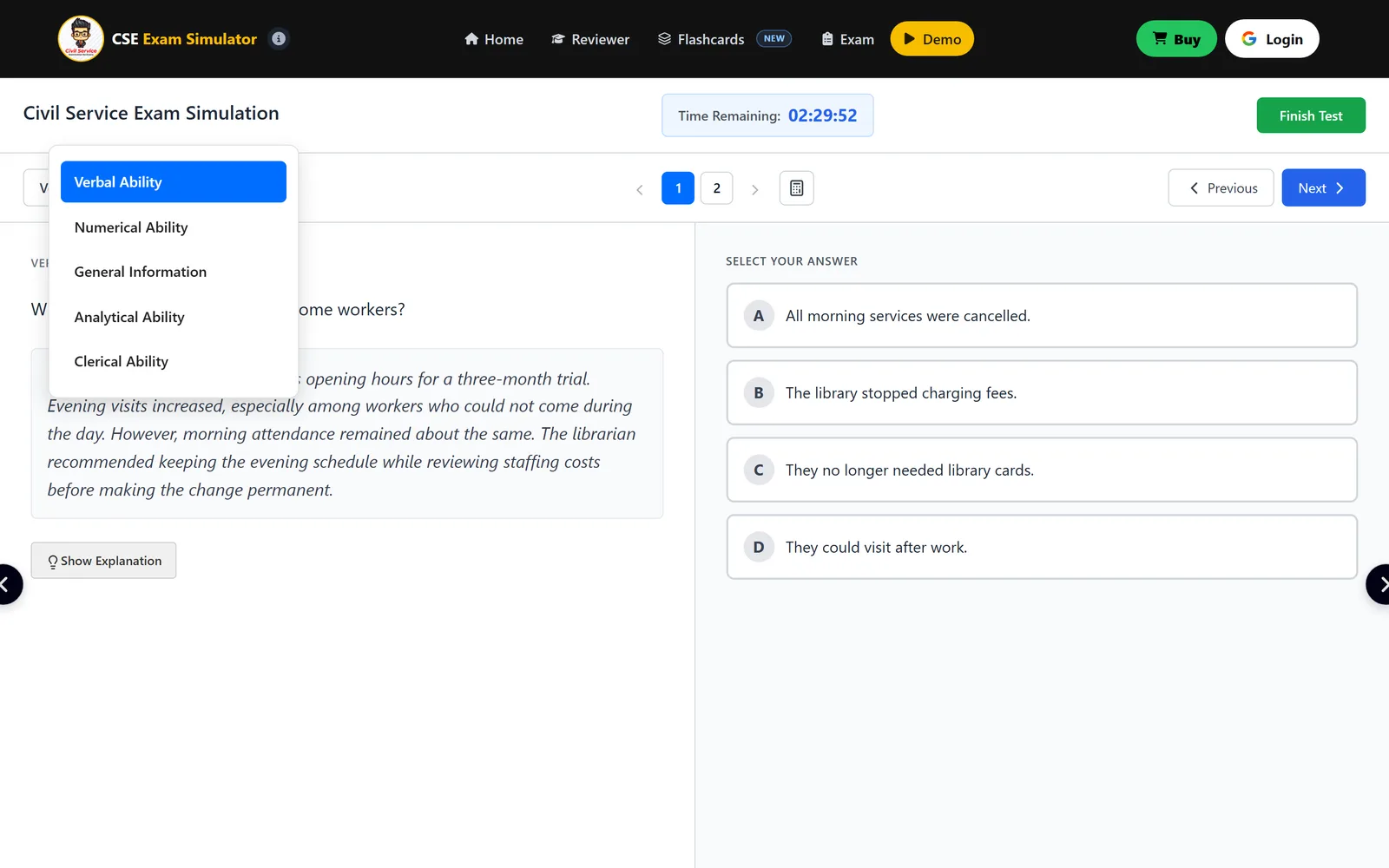
If you are filing for the Career Service Examination, the first form field you meet is a choice: Professional or Subprofessional. The decision looks small, and it shapes both what you study and which positions your eligibility is appropriate for. This post sets out the professional vs subprofessional difference using the Civil Service Commission's own wording.
CSE Exam Simulation, which publishes this blog, makes practice papers for both levels, so we have an interest in your choice and try to keep it neutral. We quote no fees. Every exam fact comes from the CSC announcement and published results, listed at the end.
What is the professional vs subprofessional difference in one sentence?
The difference is that Professional confers a second level eligibility and includes Analytical Ability, while Subprofessional confers a first level eligibility and includes Clerical Ability. Everything else in the paper is shared.
Both are sat in the Career Service Examination, Pen-and-Paper Test (CSE-PPT), which the Civil Service Commission runs. Passing either level confers civil service eligibility, which is not a licence to practise a profession. The passing rule is the same for both: "a general rating of at least 80.00", as the announcement words it. The CSC does not publish how the subtest scores combine into that rating, so we say nothing about weights.
The exam is not a board exam and the PRC does not run it. That matters for one reason: eligibility under the CSE is for positions in the civil service, not for professions covered by special laws.
What does each eligibility cover?
Each eligibility covers a different range of positions, and the CSC's announcement defines both. We quote its wording closely and add nothing.
| Professional | Subprofessional | |
|---|---|---|
| Eligibility name | Career Service Professional Eligibility | Career Service SubProfessional Eligibility |
| Level | Second level eligibility | First level eligibility |
| Positions it is appropriate for | First level (clerical) positions and second level (technical) positions, including second-level executive/managerial positions | First level (clerical) positions only |
| Exclusions | Positions that involve practice of a profession or are covered by special laws | The same exclusions |
The announcement also says the Register of Eligibles is for certification and appointment "provided the eligibles meet the qualifications and other requirements of the positions", and that it "may also be a reference for employment in the private sector".
That proviso is important. Eligibility does not guarantee a job, a permanent item, a promotion or a salary grade. A position may have other requirements. Confirm each one with the hiring agency's HR office.
Which subtest differs?
Only one subtest differs between the papers. General Information, Verbal Ability and Numerical Ability are shared, and the fifth subtest depends on your level.
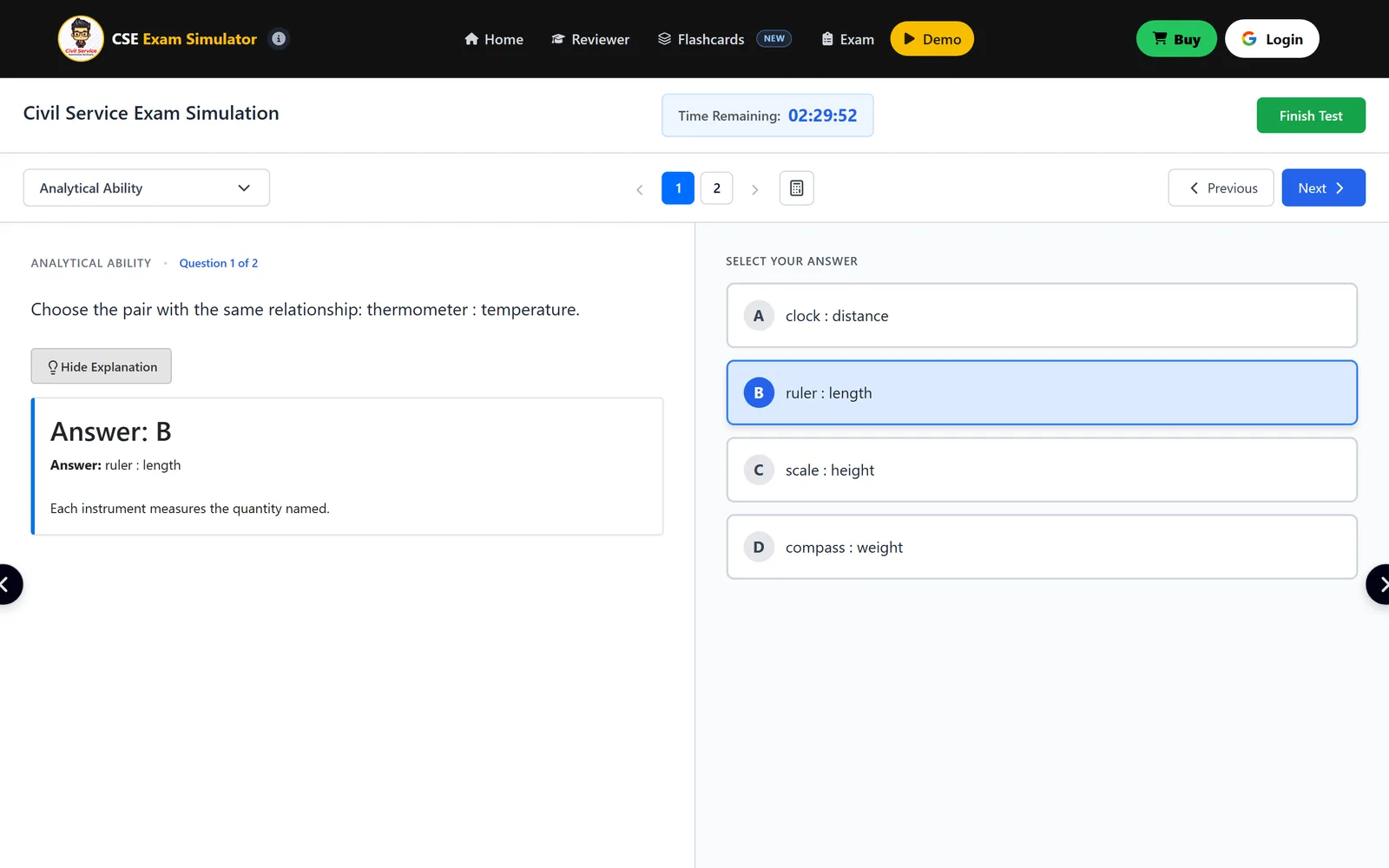
Professional adds Analytical Ability, in English, covering word analogy, symbolic logic or abstract reasoning, identifying assumptions and drawing conclusions, and data interpretation.
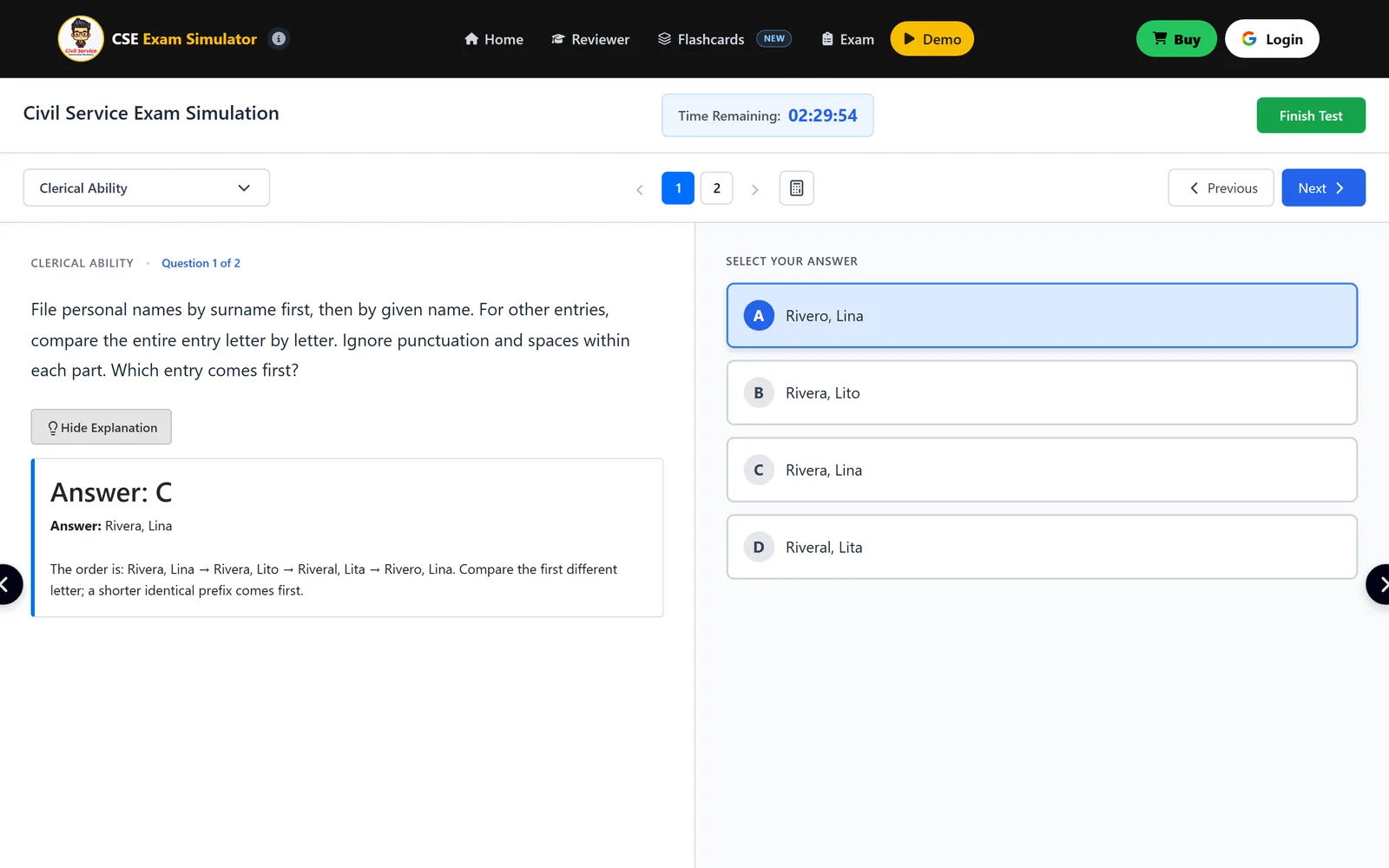
Subprofessional adds Clerical Ability, in English, covering filing and spelling.
The shared subtests are General Information (the Philippine Constitution, R.A. 6713, peace and human rights, and environment management and protection), Verbal Ability (in English and Filipino) and Numerical Ability (basic operations, number sequence and word problems).
In our practice bank, the three shared subtests use the same 1,800 items at both levels, and Analytical and Clerical have 600 items each. The shared reviewing is therefore the bulk of your preparation either way. For the full topic list, see civil service exam coverage, and for the level-specific subtest, see Analytical and Clerical Ability.
What do the published pass rates by level show?
The published rates show that both levels pass at similar overall rates, with no consistent gap. Nothing in them shows that one paper is easier.
| Sitting | Professional | Subprofessional |
|---|---|---|
| August 2026 | 14.46% (31,855 of 220,335) | 13.90% (2,864 of 20,599) |
| March 2026 | 16.18% (45,177 of 279,265) | 12.49% (3,558 of 28,482) |
| August 2025, as reported | 15.14% (45,730 of 302,028) | 14.73% (4,366 of 29,647) |
Sources: The Summit Express for August 2026, PinoyTechSaga for March 2026, and news reports for August 2025, listed below.
Most examinees sit Professional, so its rate is close to the overall rate. The Subprofessional gap in March 2026 was wide, and in August 2025 it was small. We make no claim about why. Different people sit each paper, and rates reflect the examinees as much as the paper. Do not choose a level because you expect an easier pass.
Does the level change how you prepare?
The level changes about one fifth of your preparation, because four fifths of the subtest list is shared. Plan your time with that proportion in mind.
If you take Professional, set aside regular blocks for Analytical Ability. Word analogy rewards a habit of naming the relationship between a pair of words. Symbolic logic and assumption items reward slow, careful reading, and data interpretation rewards comfort with tables.
If you take Subprofessional, set aside blocks for Clerical Ability. Filing and spelling are less about insight than about accuracy under time pressure, so short daily drills tend to help more than a long weekly session. Follow the rule each item states, and the paper's own instructions, not a rule you memorised elsewhere.
Either way, the shared subtests carry most of the work. A weak Numerical Ability result cannot be rescued by a strong fifth subtest, since the announcement states only a general rating. Spend the first weeks on the shared subtests, then add your level's subtest.
How should you choose?
Choose the level your target positions need, and use the subtest that suits you only as a tiebreaker. Three steps help.
- Start from the position. Look at the vacancy or the job you want. If you are not sure whether it is first level (clerical) or second level (technical), ask the hiring agency's HR office. Subprofessional is appropriate only for first level clerical positions, while Professional covers those and second level technical positions.
- Check the subtest. If your target is open to both, think about which fifth subtest you can prepare for. Analytical Ability asks for reasoning, and Clerical Ability asks for precision with filing and spelling.
- Think about the long run. If you may later aim for second level work, Professional covers more of the ground in the CSC's wording.
If you already work in a government office as a job-order or contractual worker, read civil service eligibility for job-order workers. To sample both levels' subtests, the free demo has 10 items. Pricing is on the buy page.
Frequently asked questions
Is Subprofessional easier than Professional?
No source says so. Published passing rates were 13.90% for Subprofessional and 14.46% for Professional in August 2026, 12.49% and 16.18% in March 2026, and 14.73% and 15.14% in August 2025 as reported. The papers also differ in their fifth subtest, so a comparison of difficulty has no basis.
Can Professional eligibility be used for clerical positions?
According to the CSC announcement, Career Service Professional Eligibility is a second level eligibility appropriate for first level (clerical) positions as well as second level (technical) positions. Appointment still depends on the position's own qualifications and requirements, so confirm with the agency's HR office.
Can I take Professional after passing Subprofessional?
The announcement's bars apply to the same level: you may not take a level you have already passed, and you may not take the same level within three months before the exam date. It does not address moving between levels. Confirm your case with your CSC Regional or Field Office before you file.
Do I need a degree to take the Professional level?
The 2026 announcement's qualifications list no education requirement. They name citizenship, a minimum age of 18 on the date of filing, good moral character and several other conditions. We can say only that no degree appears in that list. Check the current announcement for your sitting before you file.
Sources
- Examination Announcement No. 03, s. 2026: Conduct of CSE-PPT for Professional and Subprofessional Levels — Civil Service Commission
- CSE-PPT Results August 2026 — The Summit Express
- CSC announces March 2026 CSE-PPT results — PinoyTechSaga
- Over 50,000 pass August 2025 career service exam — Philippine Daily Inquirer
- 50,096 pass August 2025 career service exam — Manila Bulletin
From the publisher
Rehearse the mixed paper first.
CSE Exam Simulation is a practice simulator for the Career Service Examination, Professional and Subprofessional levels: full practice papers on a clock, with an answer and a short explanation for every item.
- 3,000 original practice items across both levels
- 15 practice papers per level, 160 items each, on a 2 hours 30 minutes timer
- An answer and a short explanation for every item
- A 12-chapter reviewer and 1,000 flashcards beside the question bank
Try the free CSE practice demo 10 practice items across all five subtests. No account needed.
About this article
Written by the editorial team that builds CSE Exam Simulation. Exam facts are checked against Civil Service Commission examination announcements and published CSC results, General Information facts against the 1987 Constitution and R.A. 6713, and every article lists its sources. How we write and check our articles.
First published .