
The CSE explained7-minute readFor civil service exam takers
Civil service exam coverage: every subtest and topic, level by level
Civil service exam coverage for the Professional and Subprofessional levels: every subtest, its topics and its language, as the CSC announcement lists them.
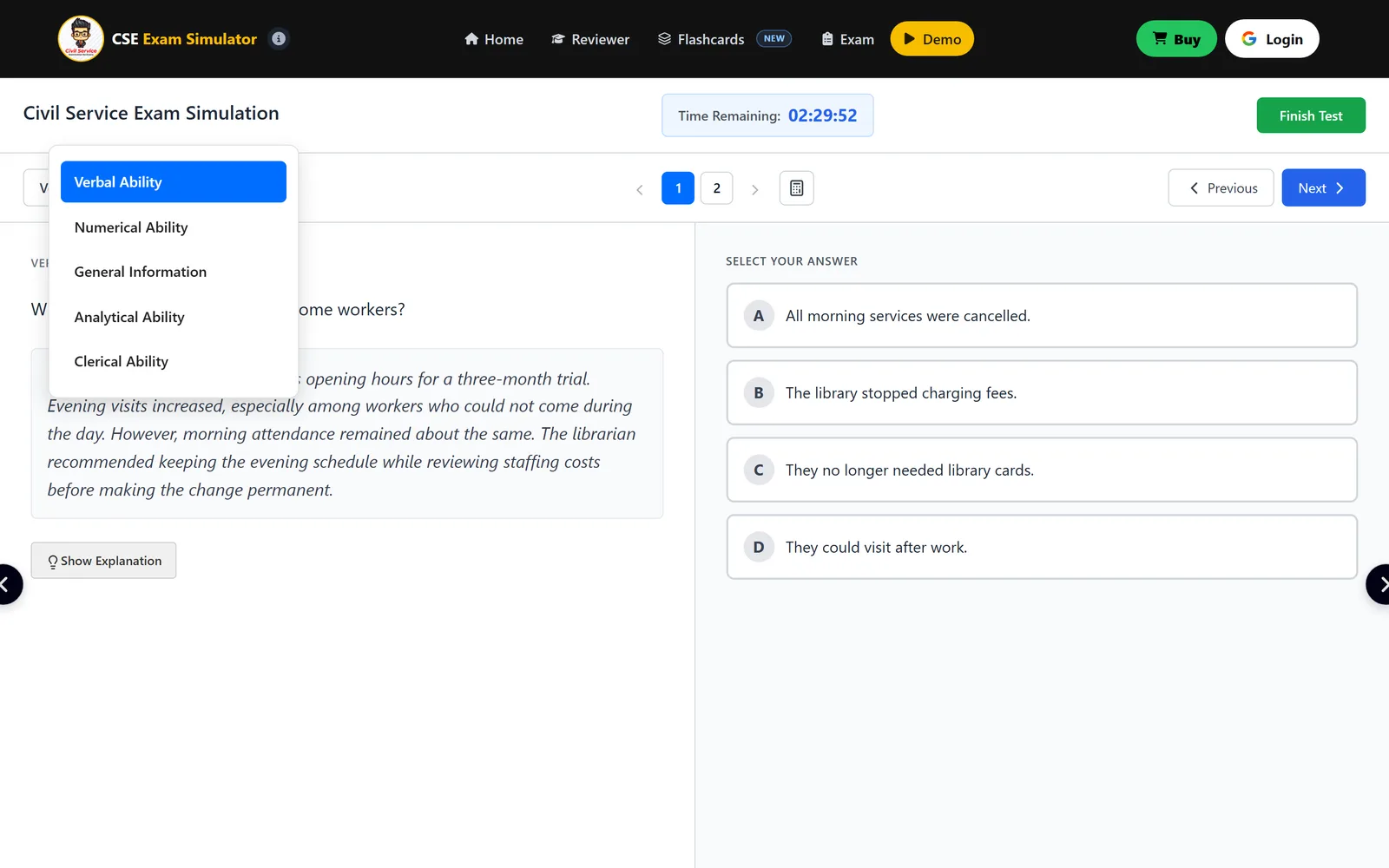
If you are asking what the civil service exam covers, the short version is four subtests per level, and you can know every topic in advance. The Civil Service Commission (CSC), which runs the exam, lists them in its examination announcement. This post sets out the civil service exam coverage for both levels of the Career Service Examination, Pen-and-Paper Test (CSE-PPT), subtest by subtest.
We use the CSC’s own wording throughout, and we say plainly where the announcement is silent. That matters most for the question reviewees ask first, how many items there are, because the answer is not in the announcement. The CSC runs this exam, not the PRC, and it confers civil service eligibility rather than a professional licence.
What is the civil service exam coverage at a glance?
The exam covers five subtests across two levels, and each level sits four of them. Both Professional and Subprofessional examinees take General Information, Verbal Ability and Numerical Ability. The fourth subtest is level-specific: Analytical Ability for Professional, Clerical Ability for Subprofessional. The list comes from CSC Examination Announcement No. 03, s. 2026.
| Subtest | Topics (as the CSC lists them) | Language | Professional | Subprofessional |
|---|---|---|---|---|
| General Information | Philippine Constitution; R.A. 6713; peace and human rights issues and concepts; environment management and protection | English | Yes | Yes |
| Verbal Ability | Word meaning; sentence completion; error recognition; sentence structure; paragraph organization; reading comprehension | English and Filipino | Yes | Yes |
| Numerical Ability | Basic operations; number sequence; word problems | English | Yes | Yes |
| Analytical Ability | Word analogy; symbolic logic or abstract reasoning; identifying assumptions and drawing conclusions; data interpretation | English | Yes | No |
| Clerical Ability | Filing; spelling | English | No | Yes |
The announcement lists topics only. It publishes no weights and no share of items per subtest, so any site that gives you a percentage split is guessing.
What is covered in General Information?
General Information covers four areas, all in English and all shared by both levels: the Philippine Constitution; the Code of Conduct and Ethical Standards for Public Officials and Employees (R.A. 6713); peace and human rights issues and concepts; and environment management and protection. The CSC’s list names areas, not article numbers, so the sensible approach is to study each area as a body of ideas.
This is the subtest where reading a good reviewer pays off most, because the content is factual. The Constitution is best learned by its structure, R.A. 6713 as norms of conduct for people who work in government, and the other two areas as concepts and issues. Our dedicated General Information study guide goes through each area.
One boundary is worth stating. The announcement lists four areas, and current events is not one of them. If a reviewer pads this subtest with news trivia, check it against the CSC list before you spend weeks on it.
How does Verbal Ability work in two languages?
Verbal Ability is the only subtest that uses two languages. The CSC lists it as English and Filipino, with six topics: word meaning, sentence completion, error recognition, sentence structure, paragraph organization and reading comprehension. Both levels sit the same subtest.
There is no separate Filipino subtest. Filipino items appear inside Verbal Ability, so a reviewee who prepares only English grammar leaves part of one subtest untouched. The announcement does not say how the items divide between the two languages, so do not rely on a rumoured ratio.
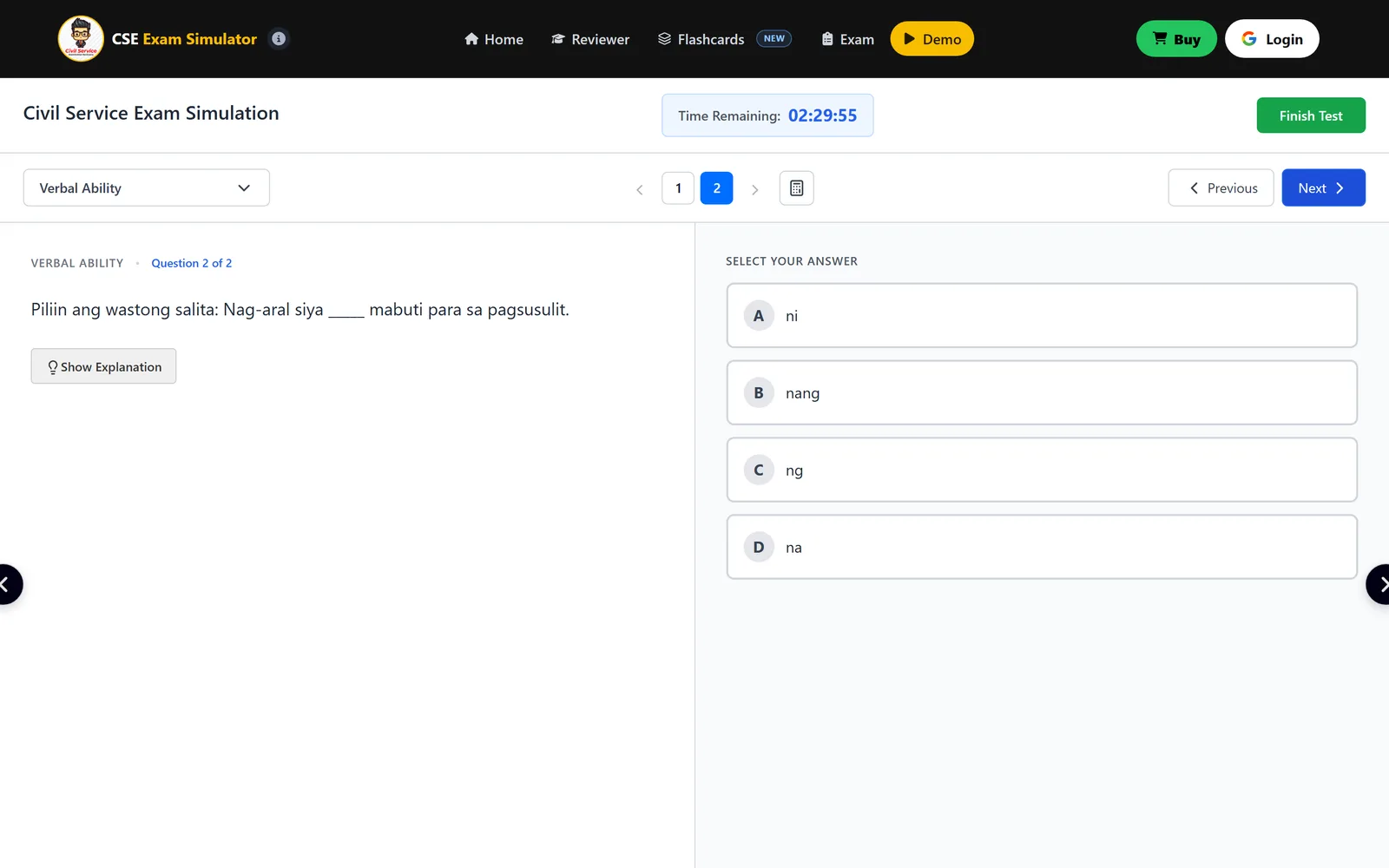
A practical habit follows from this. Treat the six topics as skills you must hold in both languages, and rotate between English and Filipino practice in the same week. The Verbal Ability guide shows how to drill each topic.
What does Numerical Ability include?
Numerical Ability has three topics, all in English: basic operations, number sequence and word problems. It is shared by both levels. The same announcement prohibits calculators of any type, including watch calculators, so the arithmetic is done by hand.
That prohibition shapes review more than the topic list does. A reviewee who has leaned on a phone calculator for years needs weeks of unaided practice with fractions, percentages and multi-step word problems before the pace feels natural. The topics are modest. The discomfort comes from doing them unaided and under time.
Number sequence is the topic people most often skip because it feels like a puzzle rather than math. It is a named topic, so it can appear, and a short daily set of sequences is cheap insurance. Our Numerical Ability guide covers speed habits, a pattern checklist and how to set up a word problem before you compute.
Which level-specific subtest will you sit?
Professional examinees sit Analytical Ability, and Subprofessional examinees sit Clerical Ability. Both are in English. Which subtest you take depends on the level you apply for, so decide the level first.
Analytical Ability has four topics: word analogy; symbolic logic or abstract reasoning; identifying assumptions and drawing conclusions; and data interpretation. Clerical Ability has two: filing and spelling. The topic lists differ in size, but the CSC states no weights, so we cannot say one is easier. Published passing rates by level are covered in the passing rate post.
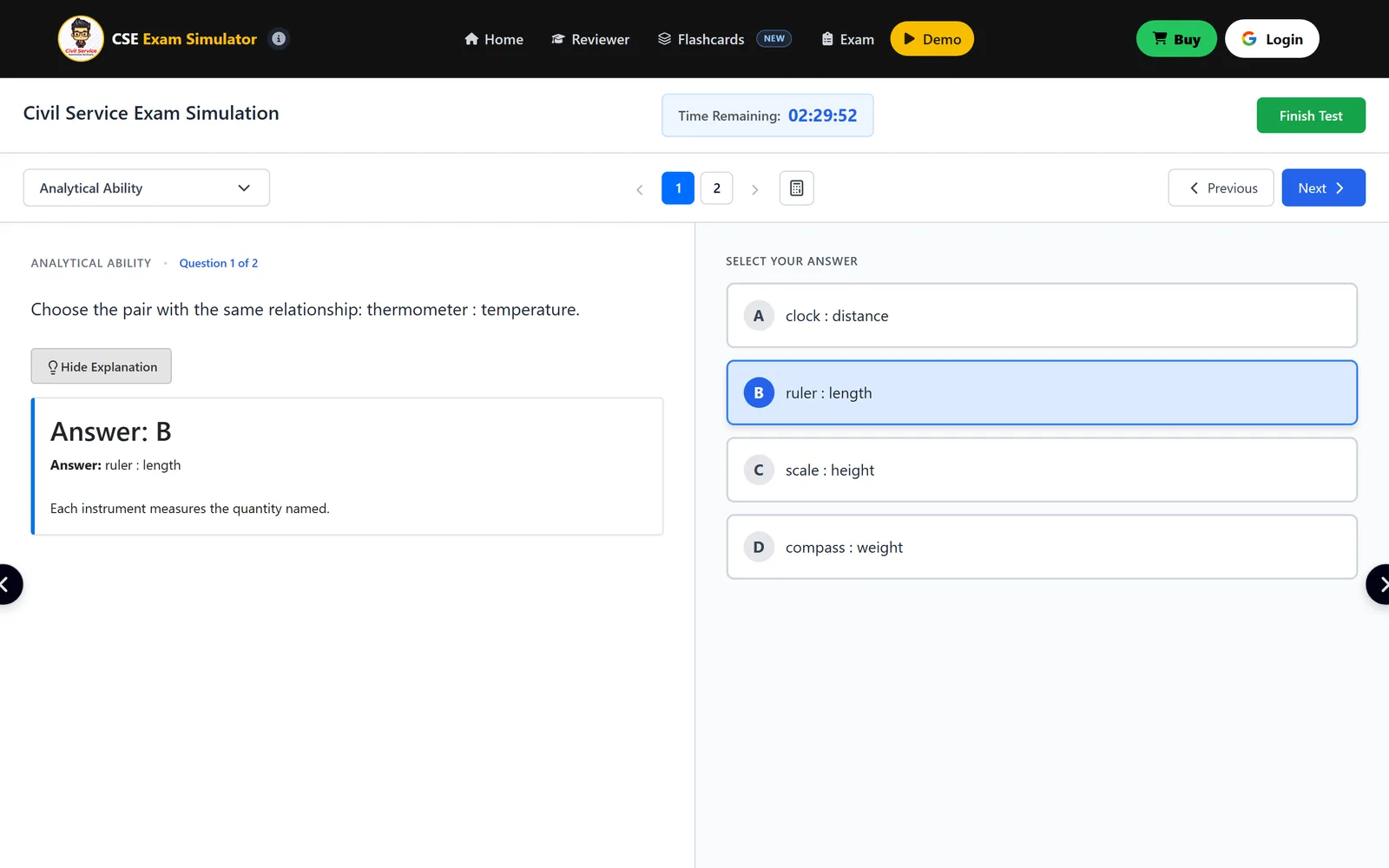
For the choice itself, read Professional vs Subprofessional. For the content of each level-specific subtest, see the Analytical and Clerical guide.
How many items are in the civil service exam, and how long is it?
The CSC announcement does not state the number of items or the time limit, so we cannot give either as an official figure. Review sites commonly report about 170 items for Professional and 165 for Subprofessional, but those figures are not in the announcement, and we have not been able to verify them against the CSC.
The honest approach is to prepare for a long mixed paper and to learn a pacing method that works from any time limit the room announces. That method is to divide the time by the items, set checkpoints at each quarter and keep moving. We teach it in the time management guide.
A note on our own numbers, so they are not mistaken for the CSC’s. Each CSE Exam Simulation practice paper has 160 items, 40 per subtest, on a 2 hours 30 minutes timer. That is the product’s practice format, designed for training, and the CSC has not set it. You can try a ten-minute sample in the free demo.
How should you use the coverage list to plan review?
Use the list as a checklist, not as a weighting. Because the CSC publishes only topics, the safest plan covers every topic at least once, then spends extra time where your practice results show weakness. Here is a simple way to start.
- Pick your level, which fixes your fourth subtest.
- Copy the topic list for your four subtests into a notebook or spreadsheet.
- Take one short practice set per subtest and mark each topic strong, shaky or unknown.
- Give the unknown topics your first two weeks, then rotate through the shaky ones.
The announcement states one general rating for passing, so no subtest can be written off. The passing score post explains that rule in the CSC’s words. The CSC also says it holds no review class and distributes no review material, so the topic list in the announcement is the only scope statement there is.
Frequently asked questions
How many items are in the civil service exam?
The CSC announcement does not state an item count. Review sites report figures, which we mention in the section above and label as unverified. Because the count is unconfirmed, plan your pacing from whatever time and instructions the examiner gives on the day, not from a number you read online.
Is the civil service exam in English or Filipino?
Verbal Ability is in English and Filipino. General Information, Numerical Ability, Analytical Ability and Clerical Ability are in English. So you will meet Filipino only inside Verbal Ability, but you need to be comfortable with it there.
Is there a separate Filipino subtest?
No. The CSC lists no separate Filipino subtest. Filipino appears within Verbal Ability, alongside English, across its six topics: word meaning, sentence completion, error recognition, sentence structure, paragraph organization and reading comprehension.
Is there another way to take the CSE besides pen and paper?
The announcement names "CSC COMEX" as another test mode, so one exists. This post and the announcement we rely on give no details about it. For its format and schedule, ask your CSC Regional or Field Office.
Sources
- Examination Announcement No. 03, s. 2026: Conduct of CSE-PPT for Professional and Subprofessional Levels — Civil Service Commission
- How to apply for August 2026 Career Service Examination-Pen and Paper Test — GMA News
- CSC releases 2026 civil service exam schedule and application timelines — Daily Tribune
From the publisher
Rehearse the mixed paper first.
CSE Exam Simulation is a practice simulator for the Career Service Examination, Professional and Subprofessional levels: full practice papers on a clock, with an answer and a short explanation for every item.
- 3,000 original practice items across both levels
- 15 practice papers per level, 160 items each, on a 2 hours 30 minutes timer
- An answer and a short explanation for every item
- A 12-chapter reviewer and 1,000 flashcards beside the question bank
Try the free CSE practice demo 10 practice items across all five subtests. No account needed.
About this article
Written by the editorial team that builds CSE Exam Simulation. Exam facts are checked against Civil Service Commission examination announcements and published CSC results, General Information facts against the 1987 Constitution and R.A. 6713, and every article lists its sources. How we write and check our articles.
First published .