
Guides7-minute readFor reviewees preparing their level-specific subtest
Analytical and clerical ability: the one civil service exam subtest that depends on your level
How to prepare for analytical and clerical ability in the civil service exam: word analogy, logic, data, filing and spelling, with drills for each.
The Career Service Examination, Pen-and-Paper Test, has five subtests, but each examinee sits four of them. Three are shared by both levels. The fourth depends on your level, and that is where analytical and clerical ability come in: one is for Professional, the other for Subprofessional.
This guide covers both so you can prepare the one you will sit, and so Professional and Subprofessional readers can see what the other paper holds. The examples are our own, written as practice patterns. The CSC publishes no review material, so treat each item's own instructions in the room as final.
Which analytical and clerical ability subtest will you take?
You take Analytical Ability if you sit the Professional level, and Clerical Ability if you sit the Subprofessional level. The Civil Service Commission's Examination Announcement No. 03, s. 2026 lists Analytical Ability for the Professional level only and Clerical Ability for the Subprofessional level only. Both are in English.
The announcement lists no Clerical Ability for the Professional level. If you are still choosing a level, read Professional vs Subprofessional first.
| Subtest | Topic | What the item asks | How to drill |
|---|---|---|---|
| Analytical | Word analogy | Choose the pair with the same relationship | Name the relationship in a sentence |
| Analytical | Logic, abstract reasoning | Decide what must follow, or what pattern continues | Translate to if-then; track one attribute at a time |
| Analytical | Assumptions, conclusions | Find the unstated link or the supported conclusion | Deny the assumption and see if the argument breaks |
| Analytical | Data interpretation | Answer from a table or chart | Read the title, units and column heads first |
| Clerical | Filing | Put names, numbers or dates in order | Apply the stated rule, then check ties |
| Clerical | Spelling | Pick the correctly spelled word | Group misspellings by type |
How do you solve word analogy items?
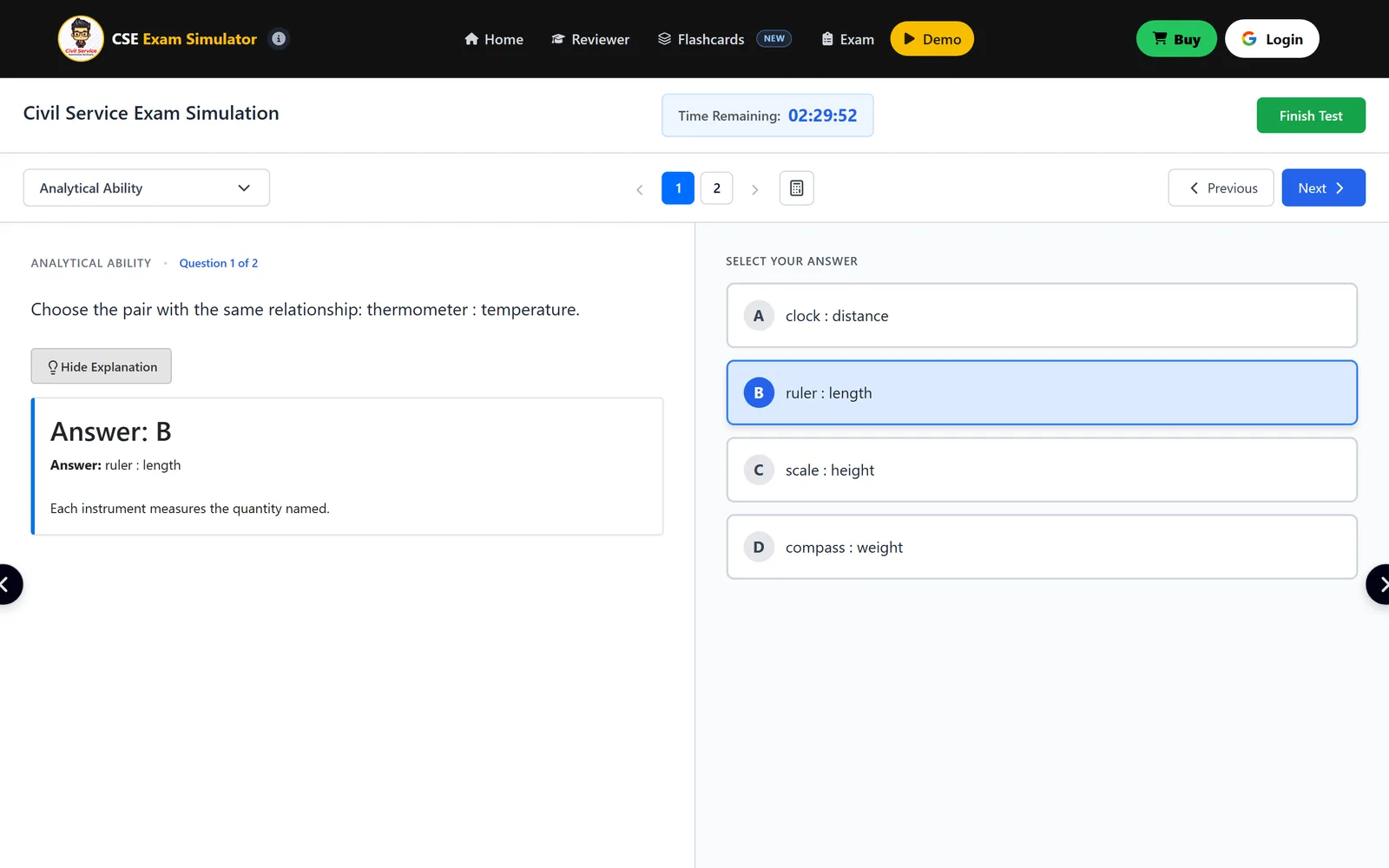
Solve a word analogy by stating the relationship between the first pair as one sentence, then testing each option with the same sentence. "Thermometer : temperature" becomes "a thermometer measures temperature", and "ruler : length" passes the same test. A weaker option fails it.
Learn the common relationship types and tag every practice item with one:
- Tool and function: knife : cut, pen : write.
- Part and whole: chapter : book, wheel : car.
- Degree: drizzle : downpour, breeze : gale.
- Cause and effect: rain : flood, fire : smoke.
- Worker and product: baker : bread, author : book.
- Opposites: brave : timid.
If two options both fit, tighten your sentence. "Drizzle is a lighter form of downpour" separates a degree analogy from one that merely pairs weather words. Keep the word order the same in your sentence and the option, because reversing it is a classic trap.
How do you handle symbolic logic and abstract reasoning?
Handle symbolic logic by translating every statement into an if-then form, then asking what must follow, not what might. Take "If a file is complete, it is stamped". If a file is not stamped, it cannot be complete, so that conclusion is valid. If a file is stamped, you cannot tell whether it is complete, so that conclusion is not valid.
For "all" statements, draw two circles. "All forms are numbered" puts the forms inside the numbered group. A document that is a form is therefore numbered, but a numbered document need not be a form.
For abstract reasoning with shapes, change one attribute at a time: count, rotation, shading, position. Write down how each attribute moves from frame to frame, and only then compare options. The paper's own instructions define the format of these items, and ours cannot predict it.
How do you separate assumptions from conclusions?
Separate an assumption from a conclusion by finding the link the argument needs but does not state. Take this argument: "The office extended its counter hours. Complaints about waiting fell the next month. Therefore the longer hours reduced waiting." The conclusion is the last sentence.
An assumption it needs: nothing else changed that could explain the drop, such as fewer applicants. Test it by denying it. If a second counter also opened that month, the argument no longer holds, so the assumption was necessary.
For "drawing conclusions" items, accept only what the passage supports. Reject options that go further, such as "always", "all" or "proves", unless the passage says the same. Reject options that bring in outside facts, however true. Practise by writing the strongest claim a passage allows in one sentence, then compare options with it.
How do you read data interpretation items?
Read a data interpretation item by looking at the title, the units and the column heads before reading the question. Many wrong answers come from the wrong unit or the wrong column, not from bad arithmetic.
Take a table of requests received: January 120, February 150, March 135. From January to February, the rise is 30 on a base of 120, which is 25%. From February to March, the fall is 15 on a base of 150, which is 10%. The three-month total is 405, and the average is 135. Note that the percent change always uses the earlier figure as its base.
Calculators are prohibited in the room, so percent change, totals and averages have to be done by hand. Round where the options allow it, and estimate first to catch a misplaced decimal. Keep the arithmetic light: the by-hand methods in the Numerical Ability guide apply here. For tables with many rows, answer from the single row or column the question names and ignore the rest.
How do you drill filing in Clerical Ability?
Drill filing by applying the rule the item states, then checking ties. Conventions differ, so the item's own instructions decide, and our examples are practice conventions only.
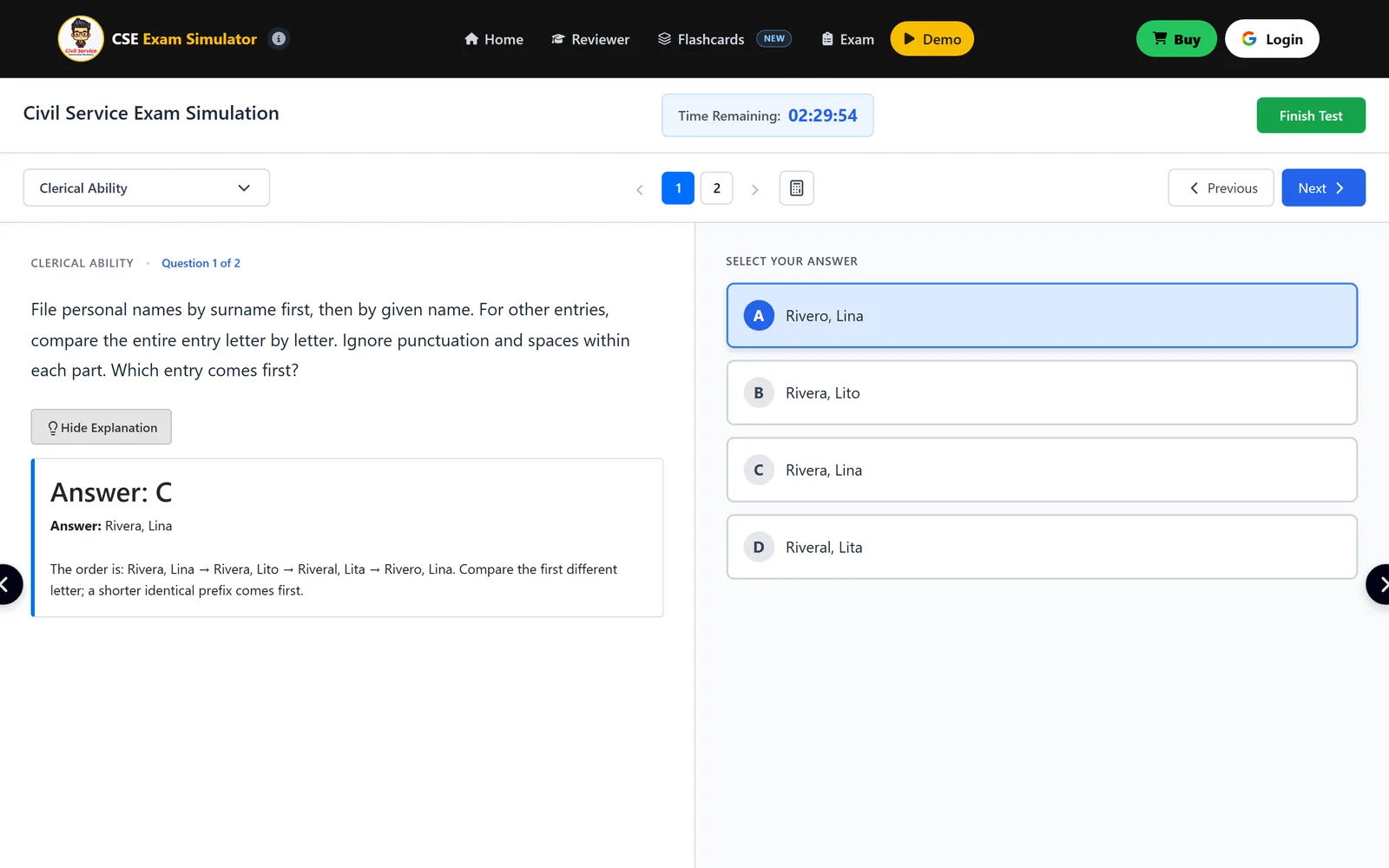
For alphabetical filing by surname, then given name, take these four names: Rivera, Lina; Reyes, Ana; Ramos, Jose; Rivera, Mario. The order is Ramos, Jose; Reyes, Ana; Rivera, Lina; Rivera, Mario. Compare surnames letter by letter ("Ra", "Re", "Ri"), and use the given name only to break the tie between the two Riveras. Filing items are quick when you know the rule, so aim to answer them well under your average pace and bank the seconds for harder items elsewhere. The demo picture at the top shows the same method: its explanation lists the sorted order and gives "Rivera, Lina" as the answer.
For numeric filing, compare whole numbers by value: 482, 4,028 and 4,082 sort in that order. For dates, sort by year, then month, then day. Surnames with prefixes such as "dela" are where conventions vary, so follow the item.
How do you drill spelling in Clerical Ability?
Drill spelling by grouping misses by type and rehearsing each type, instead of memorising a thousand words. Types worth tracking: doubled letters (occurrence, accommodate, necessary), silent letters (government, environment), the "ie" and "ei" pattern (receive), and endings (maintenance, privilege, schedule).
For each type, write the word, say it with exaggerated syllables ("gov-ern-ment"), and test yourself on a different day. Spelling items usually show several versions of one word and ask for the correct one, so practise by looking at all options before choosing. Cover them, spell the word yourself and then look.
Spelling is listed for Clerical Ability, not for Verbal Ability. The Subprofessional level also takes Verbal Ability, covered in the Verbal guide. CSE Exam Simulation has 600 items in each of Analytical Ability and Clerical Ability, each with an answer and a short explanation, and the free demo lets you try one first.
Frequently asked questions
Does the Professional exam have clerical items?
The CSC announcement lists Clerical Ability only for the Subprofessional level. Professional examinees are listed for Analytical Ability instead. Both levels share General Information, Verbal Ability and Numerical Ability.
What filing rules does the exam use?
Follow each item's instructions. We have no CSC rulebook for filing, so we cannot tell you which convention applies to a given item. Practise the common conventions, such as surname then given name, but let the instructions on the paper decide.
Is Analytical harder than Clerical?
We make no such claim. The two subtests belong to different levels and test different skills, and the CSC publishes no difficulty data for either. Prepare the one for your level using timed sets and read the explanation for each miss.
Sources
From the publisher
Rehearse the mixed paper first.
CSE Exam Simulation is a practice simulator for the Career Service Examination, Professional and Subprofessional levels: full practice papers on a clock, with an answer and a short explanation for every item.
- 3,000 original practice items across both levels
- 15 practice papers per level, 160 items each, on a 2 hours 30 minutes timer
- An answer and a short explanation for every item
- A 12-chapter reviewer and 1,000 flashcards beside the question bank
Try the free CSE practice demo 10 practice items across all five subtests. No account needed.
About this article
Written by the editorial team that builds CSE Exam Simulation. Exam facts are checked against Civil Service Commission examination announcements and published CSC results, General Information facts against the 1987 Constitution and R.A. 6713, and every article lists its sources. How we write and check our articles.
First published .