
Study strategy8-minute readFor civil service exam takers in the final month
Civil service exam tips for the last 30 days, and for keeping calm on the day
Civil service exam tips for the final 30 days: a week-by-week plan, what to leave at home, and how to handle exam anxiety and a blank mind.
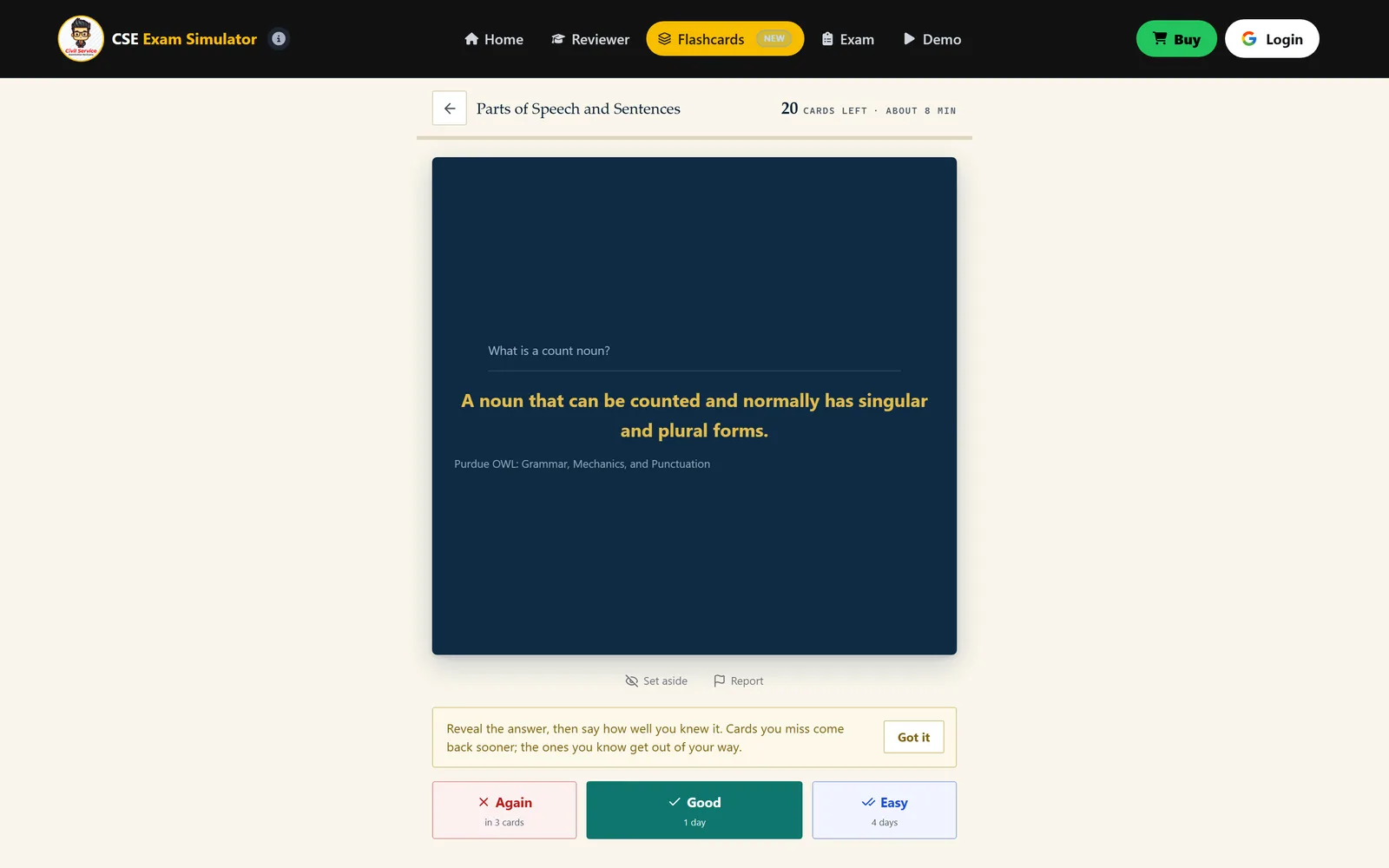
You have about four weeks until the Career Service Examination, Pen-and-Paper Test (CSE-PPT), and the question is no longer "what should I study" but "what should I stop doing". These civil service exam tips are for the final 30 days: a week-by-week plan, a list of what to leave at home, and a way to stay steady if your nerves rise.
We also cover anxiety here, because the final month is when it shows up. Nothing below is a guarantee. The Civil Service Commission (CSC) publishes no formula that tells you how many items you need, so the goal is a steady, rehearsed paper rather than a perfect one.
Which civil service exam tips matter most in the last month?
The last month is for rehearsal and repair, not for new content. By now you have met every topic at least once. What separates a calm sitting from a rushed one is whether you have practised the whole mixed paper under a clock and fixed the gaps it exposed.
The CSC announcement says passing needs "a general rating of at least 80.00" and states only that rating (CSC Examination Announcement No. 03, s. 2026). It does not publish how subtests combine, so treat all subtests as live. Three jobs fill the month: timed full papers, repair of your weakest subtest, and daily recall of General Information. Reading yet another PDF is not one of the jobs.
For context, 14.41% of examinees passed in August 2026, according to a secondary report of the results. That is a reason for a deliberate plan, not for panic.
What should weeks four and three out look like?
In weeks four and three, sit two timed full papers per week and spend the rest of your study time repairing the subtest where you lose the most items. The first full paper is a diagnostic: it shows where your marks go, which is more useful than how many you got.
After each paper, review every wrong answer and every guess that happened to be right. Write one line per error: the topic, why you missed it, and the fix. Group the lines by subtest. The subtest with the longest list gets your daily repair block of 45 to 60 minutes.
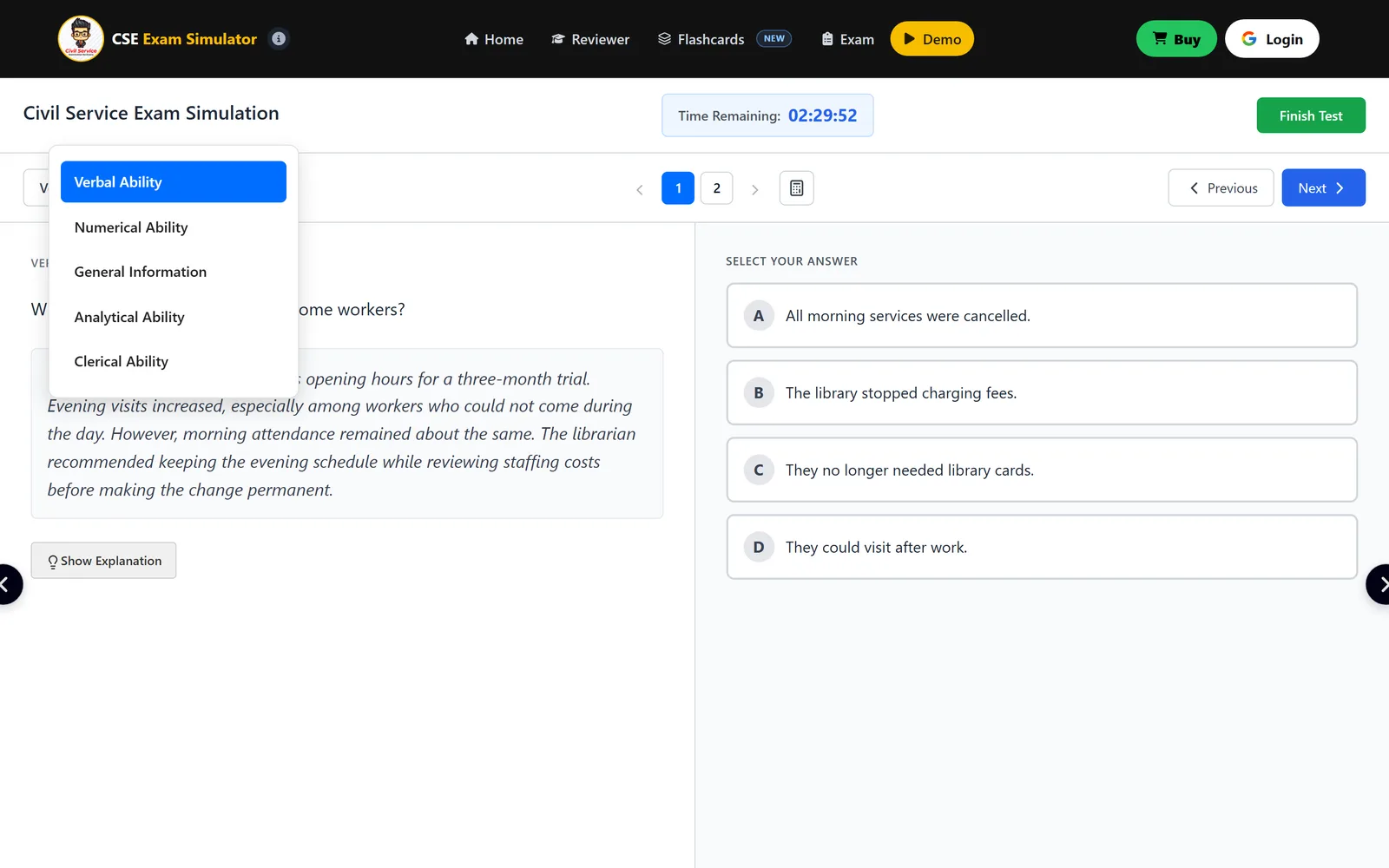
Keep the other subtests warm with short sessions, and read our 10-week plan if you want to see where this month sits in a full review. The CSC announcement puts Filipino items in Verbal Ability and keeps the other subtests in English, so do not let it slip. Numerical Ability has no calculator on exam day, so do the arithmetic by hand. Our practice papers run on a 2 hours 30 minutes timer, about 56 seconds per item, which is the product's own format and not the CSC's.
What belongs in week two before the exam?
In week two, keep one full paper at the start of the week, then shift to General Information recall and error-log review. General Information is the most memory-heavy subtest, and recall decays quickly if you do not retrieve it. The CSC lists four areas: the Philippine Constitution; R.A. 6713, the Code of Conduct and Ethical Standards for Public Officials and Employees; peace and human rights issues and concepts; and environment management and protection.
Use flashcards for short daily sessions, and see our General Information guide for how to study each area. Our reviewer hub has 1,000 cards in 20 decks at /flashcards/, with 50 free. Flip each card only after you have said the answer aloud.
Reread your error log from weeks four and three. Any error that appears twice is a pattern, and patterns are what to fix now. If your weakest subtest has not improved, give it ten more minutes a day rather than another hour on a subtest you already handle well.
The month at a glance: what to do and what to skip
A short table keeps the month in one view. Treat the hours as suggestions and adjust them to your work or classes. The pattern matters more than the numbers: full papers early, repair in the middle, and a taper at the end.
| Week | Do | Don't |
|---|---|---|
| Four out | Sit one diagnostic full paper; build the error log; pick your weakest subtest | Start a new reviewer or switch method |
| Three out | Sit two timed full papers; daily repair block on the weakest subtest | Skip Numerical because there is no calculator |
| Two out | One full paper; General Information recall; reread the error log | Cram a topic you have never seen |
| Exam week | Light recall only; confirm your venue and ID; sleep on schedule | Sit a hard full paper after the third day |
| Night before | Pack, glance at the one-page sheet, sleep | Study until midnight |
Confirm your exam venue, the time and the items you must bring from your own application papers. Check the CSC's announcement for your sitting rather than relying on this post for logistics.
What should you do in exam week and the night before?
In exam week, do light recall only and protect your sleep. A full practice paper in the final days is optional: if you sit one, do it no later than three days out, so a bad score cannot follow you into the room. A paper two or three days before the exam, reviewed calmly, can show you that your pacing holds. A paper the night before only adds fear.
The night before, pack your bag, glance at the one-page sheet for no more than twenty minutes, and stop. Eat a normal dinner, set two alarms, and plan your trip to the venue with spare time for traffic. The 2026 sittings were held on Sundays, so check how early transport runs in your area.
Studying the night before is not forbidden. It just rarely helps, and it often costs sleep, which affects attention the next morning. If you feel the urge, review the sheet once and put it away. A rested mind recalls more than a tired one.
What must you leave at home on exam day?
Leave every prohibited item at home, because breaking the rules cancels your exam. The CSC announcement prohibits calculators of any kind, including watch calculators; cellular phones, smart phones and smart watches, and pens or eyeglasses with built-in cameras, plus other gadgets; books, dictionaries and other printed material; and scratch work on any piece of paper, part of the body or clothing. It also prohibits photographing the test booklet or answer sheet, posting test questions online, tearing booklet pages, copying, crib sheets and taking the booklet or answer sheet out of the room.
The consequence is a cancelled exam and possible liability under R.A. No. 9416, the Anti-Cheating Law. Follow the room's instructions on where you may work out answers. We do not state where scratch work is allowed, because the announcement does not say.
If you want a deeper checklist of the schedule and the room, see our guide to the civil service exam schedule and exam day.
How do you keep calm in the room, and what if your mind goes blank?
Some nervousness is normal and does not mean you are unprepared. A dependable defence is exposure: the more full timed papers you have sat, the more familiar the pressure feels. That is the real reason to practise in the final month, beyond the score.
If your mind goes blank on an item, use a reset routine of about twenty seconds. Put your pencil down, take three slow breaths, and drop your shoulders. Then mark the item, skip it and come back. A blank on one item is common, and it passes more quickly when you move on than when you stare. If a whole subtest feels blank, answer the items you can, return to the rest, and remember that the CSC states one general rating for the paper.
For the weeks before the exam, protect the basics: regular sleep, meals, some movement and one person you can talk to. Avoid drastic changes such as new supplements or all-night study.
Frequently asked questions
Should I study the night before the civil service exam?
A short look is fine, but long sessions rarely help. Glance at your one-page sheet of repeated errors for no more than twenty minutes, then pack, eat normally and sleep. Attention and recall the next morning depend more on rest than on one more hour of review. Do not start any new topic at that point.
What if I blank on a whole subtest?
Answer the items you can, mark the rest, and return to them after a breath. The CSC announcement states only a general rating of at least 80.00 and does not describe a separate minimum per subtest. A weak stretch is not an automatic failure, so keep working through the paper steadily rather than giving up on it.
Is it normal to feel unprepared a month before the exam?
Yes. Most reviewees feel behind in the final month, because they can see every gap at once. Turn the feeling into a list: sit a timed paper, write down the topics you lose items on, and attack the longest list first. If the worry stops you from sleeping or working, talk to a health professional.
Should I sit a full practice paper in the final week?
One is reasonable early in the week, but not the night before. Sit it under the clock, review the errors calmly, and treat the score as information about pacing rather than a prediction. A practice score is the share of practice items you got right. It is not a CSC rating, and the CSC publishes no conversion.
Sources
- Examination Announcement No. 03, s. 2026: Conduct of CSE-PPT for Professional and Subprofessional Levels, 09 August 2026 — Civil Service Commission
- CSC releases 2026 civil service exam schedule and application timelines — Daily Tribune
- How to apply for August 2026 Career Service Examination-Pen and Paper Test — GMA News
- CSE-PPT Results August 2026 — The Summit Express (secondary)
From the publisher
Rehearse the mixed paper first.
CSE Exam Simulation is a practice simulator for the Career Service Examination, Professional and Subprofessional levels: full practice papers on a clock, with an answer and a short explanation for every item.
- 3,000 original practice items across both levels
- 15 practice papers per level, 160 items each, on a 2 hours 30 minutes timer
- An answer and a short explanation for every item
- A 12-chapter reviewer and 1,000 flashcards beside the question bank
Try the free CSE practice demo 10 practice items across all five subtests. No account needed.
About this article
Written by the editorial team that builds CSE Exam Simulation. Exam facts are checked against Civil Service Commission examination announcements and published CSC results, General Information facts against the 1987 Constitution and R.A. 6713, and every article lists its sources. How we write and check our articles.
First published .