
Guides7-minute readFor reviewees who dread the math part
Civil service exam numerical ability: word problems, number series and math without a calculator
Prepare for civil service exam numerical ability with no calculator: speed habits, a number series checklist and word problem setups.
Many reviewees skip the math because they assume it will be easy arithmetic, or because they assume it will be impossible. Neither is a plan. Civil service exam numerical ability is a short list of topics that rewards habits you can build in a few weeks, even if you have not done long division since high school.
This guide covers the three listed topics with worked examples that we checked line by line. Every example is meant to be done without a calculator, because the room does not allow one. Peso amounts below are hypothetical, written like "P12,800", and are not from any CSC item.
What does civil service exam numerical ability cover?
The Civil Service Commission's Examination Announcement No. 03, s. 2026 lists three topics for Numerical Ability: basic operations, number sequence and word problems. The subtest is in English, and it is shared by the Professional and Subprofessional levels.
The announcement does not say how many items come from each topic, so we do not guess. The table below maps each type of problem to a recognition cue, a shortcut and a mini-example, and every answer in it can be reached by hand.
| Problem type | What to recognise | Shortcut | Mini-example |
|---|---|---|---|
| Percent of a number | "x% of", discount, commission | Turn it into a fraction | 12.5% of 480 is 480 ÷ 8 = 60 |
| Percent change | "increased by", "reduced by" | Build 15% from 10% plus 5% | P12,800 up 15% is 12,800 + 1,920 = 14,720 |
| Ratio sharing | "shared in the ratio" | Add the parts, divide, multiply | P18,000 in 2:3 gives 7,200 and 10,800 |
| Rate and work | "per hour", "in 3 hours" | Rate × time; split mixed time | 45 forms an hour for 3 h 20 min is 150 |
| Average | "mean", "average of" | Sum ÷ count | (78 + 84 + 90 + 88) ÷ 4 = 85 |
| Number series | A list with a blank | Run the pattern checklist | 7, 12, 17, 22, then 27 |
How do you practise for a paper with no calculator?
Practise with no calculator from the first day, so that by exam week the hand methods feel normal. The announcement bans calculators of any type or kind, including watch calculators, and bans scratch work on any piece of paper, skin or clothing. It does not tell you where working is allowed, so follow the room's instructions on that and plan to do most steps in your head.
Three habits make this realistic. First, memorise the equivalents you will use constantly: 1/8 is 12.5%, 1/6 is about 16.7%, 3/8 is 37.5%, 1/5 is 20%, 1/3 is about 33.3% and 2/3 is about 66.7%. Second, estimate before computing. In 38% of 1,205, think "40% of 1,200 is 480, and 38% is a little less", so any option far from 480, such as 380 or 600, can be dropped. Third, keep every step small enough to do in one breath.
Our schedule and exam-day guide lists the full set of prohibited items.
How do you build speed in basic operations?
Build speed in basic operations by replacing the long method with a one-line trick whenever the numbers allow it. Four tricks cover most of what you will meet, and each has a check you can do in your head.
- Multiply by 25: 48 × 25 is 48 × 100 ÷ 4, which is 4,800 ÷ 4 = 1,200.
- Split a multiplier: 17 × 14 is 17 × 10 + 17 × 4, which is 170 + 68 = 238.
- Use a round number: 99 × 36 is 100 × 36 − 36, which is 3,600 − 36 = 3,564.
- Scale a division: 1,260 ÷ 15 becomes 2,520 ÷ 30 when you double both numbers, which is 252 ÷ 3 = 84.
Drill these in sets of ten items with a timer, and check each answer by estimating first. If your estimate and your answer disagree by a power of ten, you misplaced a zero, which is the most common slip under pressure. For percent problems, build from 10% and 1%: 15% of P12,800 is 1,280 plus half of 1,280, which is 1,280 + 640 = 1,920.
How do you solve number sequences quickly?
Solve a number sequence by running the same checklist in the same order every time, because a fixed order finds the pattern faster than inspiration does. Stop at the first rule that fits every gap.
- Constant difference: 7, 12, 17, 22, __ adds 5 each time, so the next term is 27.
- Constant ratio: 3, 6, 12, 24, __ doubles each time, so the next term is 48.
- Difference of differences: 2, 3, 5, 8, 12, __ has gaps of 1, 2, 3, 4, so the next gap is 5 and the term is 17.
- Squares and cubes: 1, 4, 9, 16, 25, __ gives 36; 1, 8, 27, 64, __ gives 125.
- Two interleaved series: 5, 2, 10, 4, 20, 8, __ is two series, 5, 10, 20 and 2, 4, 8, both doubling, so the next term is 40.
- Multiply, then add: 2, 5, 11, 23, __ follows "double and add 1", so the next term is 47.
If none fits, test the pattern on the first two gaps only, then confirm it on a third. A rule that explains only some terms is not the rule.
How do you set up word problems before computing?
Set up a word problem in four short steps, and do not touch a number until the third. Write what is asked, name the unknown, turn the sentence into one equation or ratio, then compute and check that the answer is reasonable.
Here are three worked setups. A clerk encodes 45 forms an hour; in 3 hours 20 minutes she encodes 45 × 3 = 135 plus one third of 45, which is 15, so 150 forms. A bonus of P18,000 is shared in the ratio 2:3, so there are 5 parts of P3,600, giving P7,200 and P10,800, which add back to P18,000. Ana is twice as old as Ben, and in 6 years their ages add to 51: Ben is b, Ana is 2b, so (b + 6) + (2b + 6) = 51, which gives 3b = 39 and b = 13; Ana is 26.
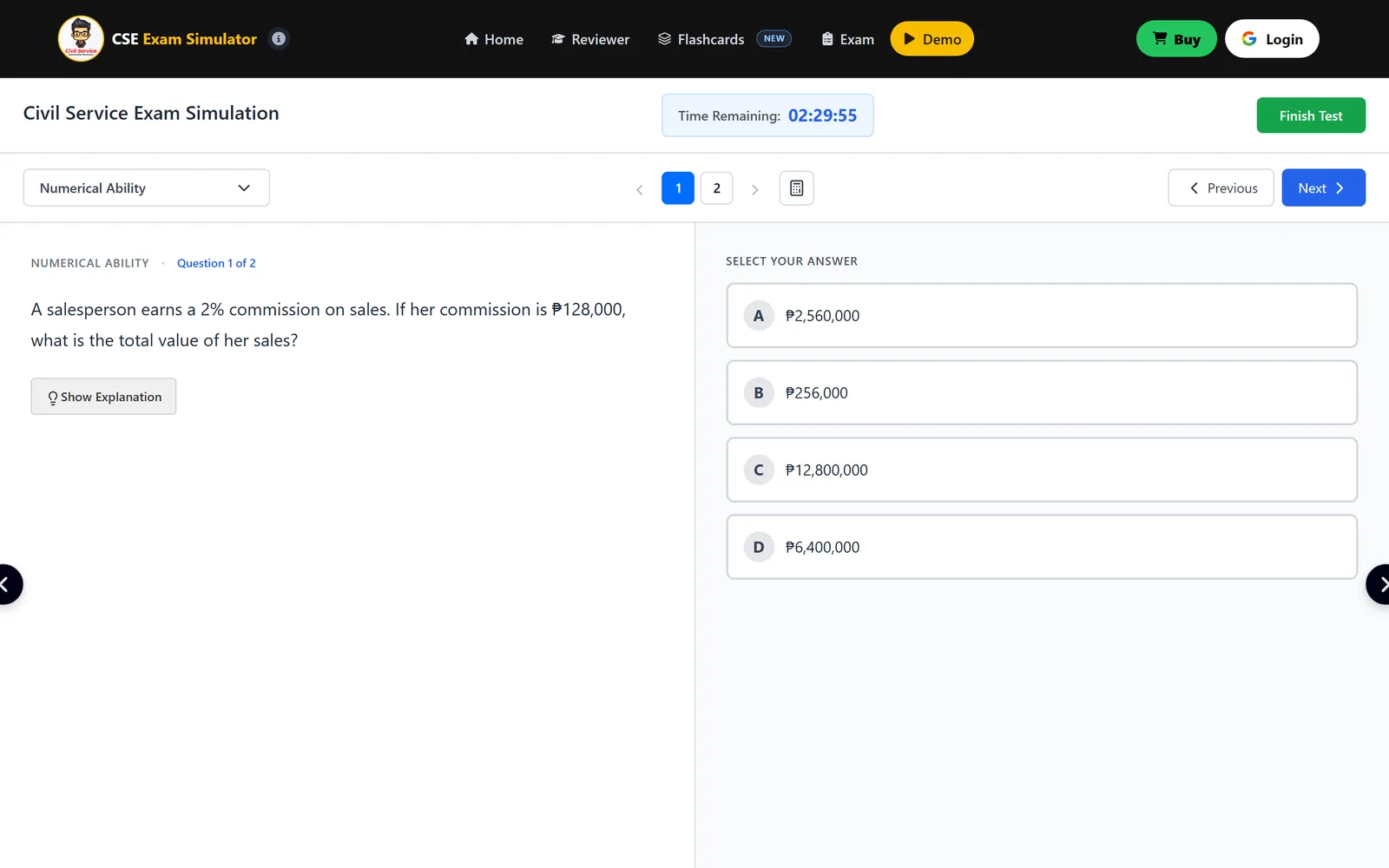
For a commission item, 2% of P85,000 is 2 × P850 = P1,700. Always run the reasonableness check: Ben at 13 and Ana at 26 fits "twice as old".
What does a two-week Numerical block look like?
A two-week Numerical block alternates hand-method drills with timed sets, ending on mixed word problems. Keep each session to about forty-five minutes, and keep the fractions and percent table on your wall until you no longer need it.
| Days | Focus | Task |
|---|---|---|
| 1-2 | Equivalents and estimation | Recite the fraction and percent table; estimate ten answers |
| 3-4 | Basic operations | The four tricks above, ten items a day, timed |
| 5-6 | Percent problems | Discount, commission and percent change, built from 10% |
| 7 | Rest | Flashcards only |
| 8-9 | Number sequences | The six-step checklist on twenty sequences |
| 10-11 | Word problems | Ratio, rate, average and age setups |
| 12 | Mixed timed set | Set a pace; see the pacing guide |
| 13 | Repair | Redo every miss by a different method |
| 14 | Rest | Light recall only |
In CSE Exam Simulation, the Numerical Ability items come with an answer and a short explanation, and the free demo has 10 items across all five subtests. Use the explanation to check whether your method was the efficient one, not only whether your answer was right.
Frequently asked questions
Is a calculator allowed in the civil service exam?
No. The CSC announcement prohibits calculators of any type or kind in the room, including watch calculators, along with phones and other gadgets. Bringing one risks cancellation of your examination, so train every method to work by hand.
Where do I write my solutions?
Follow the instructions given in the room. The announcement bans scratch work on any piece of paper, on any part of the body or skin, or on clothing, and it does not say where working is allowed. Practise doing steps mentally so that you depend on written working as little as possible.
What math topics come out?
The announcement lists three Numerical Ability topics: basic operations, number sequence and word problems. It publishes no weights or item counts for them. Review all three, with extra time on whichever you miss most in timed sets.
I am weak at math. Can I still pass?
The announcement states a single general rating of at least 80.00 for passing, and it states no separate minimum for any subtest. A weak subtest therefore still counts toward that rating, so improving it is worth the effort, even if you do not reach your strongest subtest's level. Read what the general rating means.
Sources
- Examination Announcement No. 03, s. 2026: Conduct of CSE-PPT for Professional and Subprofessional Levels — Civil Service Commission
- How to apply for August 2026 Career Service Examination-Pen and Paper Test — GMA News
- CSC releases 2026 civil service exam schedule and application timelines — Daily Tribune
From the publisher
Rehearse the mixed paper first.
CSE Exam Simulation is a practice simulator for the Career Service Examination, Professional and Subprofessional levels: full practice papers on a clock, with an answer and a short explanation for every item.
- 3,000 original practice items across both levels
- 15 practice papers per level, 160 items each, on a 2 hours 30 minutes timer
- An answer and a short explanation for every item
- A 12-chapter reviewer and 1,000 flashcards beside the question bank
Try the free CSE practice demo 10 practice items across all five subtests. No account needed.
About this article
Written by the editorial team that builds CSE Exam Simulation. Exam facts are checked against Civil Service Commission examination announcements and published CSC results, General Information facts against the 1987 Constitution and R.A. 6713, and every article lists its sources. How we write and check our articles.
First published .