
Study strategy6-minute readFor reviewees who run out of time
Civil service exam time management: pacing a long mixed paper
Civil service exam time management: a pacing formula, quarter checkpoints, a skip-and-return rule and answer-sheet habits you can train on full practice papers.
Running out of time is a different failure from not knowing the content. You know the grammar rule, you can do the percent, and you still leave the last stretch of the paper blank. Civil service exam time management is the skill of spending a fixed budget of seconds across a long, mixed set of subtests.
This guide teaches a pacing method you can use whatever the room announces, then shows how to train it. The exam is a pen-and-paper test run by the Civil Service Commission (CSC), and every tip here is a study technique, not a CSC rule.
Why is civil service exam time management a pacing problem?
The civil service exam is a pacing test because one sitting mixes several subtests under a single clock, and the passing rule counts them all. The CSC's announcement says passing requires a general rating of at least 80.00 and states no separate rating per subtest. A rushed final subtest therefore costs you as much as a weak first one.
The announcement gives no item count and no time limit. Review sites commonly report about 170 items for Professional and 165 for Subprofessional, but the CSC announcement does not state item counts or time limits. We do not rely on those figures, and you should not build a plan on them.
Plan instead for the number you will hear in the room. A method that starts from "time given" and "items in the booklet" works for any paper. The rest of this guide builds that method, and the coverage guide lists the subtests it must stretch across.
What is the pacing formula?
The pacing formula is total seconds divided by the number of items, which gives your average seconds per item. Convert the minutes to seconds first, because seconds are the unit you actually feel.
Two practice drills show the arithmetic. A 60-minute drill of 50 items gives 3,600 ÷ 50 = 72 seconds per item. A 30-minute block of 40 items gives 1,800 ÷ 40 = 45 seconds per item.
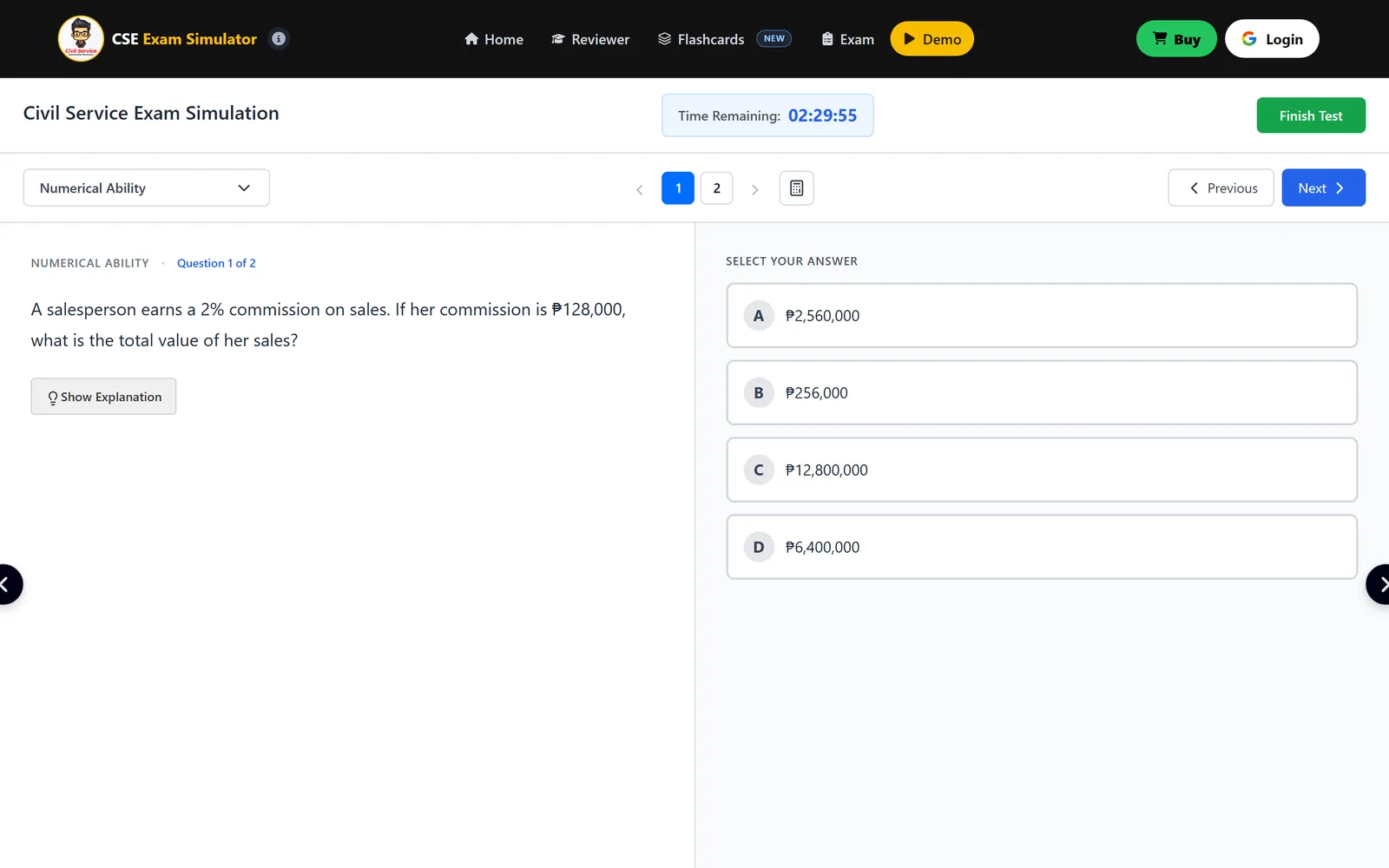
Now the worked case from our own product, labelled as its design and not the CSC's. A CSE Exam Simulation practice paper has 160 items, set on a 2 hours 30 minutes timer, which comes to about 56 seconds per item. That average hides a spread. Some items take 20 seconds, and a reading passage may take 90, so your job is to bank time on the quick items and spend it on the slow ones.
When the proctor announces the time in the room, do the division right away. Hold on to the number.
How do checkpoints by quarter work?
Checkpoints by quarter compare the share of time used with the share of items finished. At 25%, 50% and 75% of the clock, you should have finished about the same share of the items. Pick the checkpoints before the exam so you do not have to decide anything under pressure.
| Checkpoint | Share of items done | If you are behind |
|---|---|---|
| 25% of the time | A quarter of the paper, which is 40 items in the practice paper | Stop rereading; skip any item that stalls you |
| 50% of the time | Half the paper | Drop to a first-pass rule: answer what you can in under 30 seconds |
| 75% of the time | Three quarters of the paper | Guess-and-move on slow items; keep the last quarter reachable |
| 100% of the time | Every item resolved | Use the last minutes only on blanks |
A few items behind is normal and recoverable. Being a whole subtest behind at the halfway mark is not, and that is when to switch to the first-pass rule.
Check the clock only at checkpoints and at subtest changes, not after each item. Looking at it constantly costs more seconds than it saves.
Which items should you skip and return to?
Skip an item when you have spent about twice your average seconds on it without a clear path to an answer. Mark it mentally, move on and come back if time remains. One hard item can eat the time of several easy ones, and every item counts the same toward your rating.
Items worth skipping on the first pass are long arithmetic chains, passages with several dense questions, and logic puzzles where you cannot yet see the structure. Items worth answering at once are word meaning, spelling, filing and any item where one option is clearly wrong.
Switching between subtests has its own cost. You change language, mental mode and tools, from Filipino grammar to a number series to a constitutional article. Expect the first one or two items after a switch to run slow, and do not count them against your pace.
How do you keep your answer sheet in order?
Keep your answer sheet in order by checking that item numbers and answer rows match each time you turn a page. The CSC announcement refers to the booklet and the answer sheet and prohibits taking either out of the room. A mis-aligned sheet is the cheapest way to lose points you earned.
Four habits protect you. First, fill the row for the item number you are on, saying the number silently. Second, if you skip an item, skip its row too, and keep the gap visible. Third, check the alignment at the bottom of every page. Fourth, use the marking method the room instructs, and follow the proctor on whether you may mark the booklet itself.
In the last minutes, do not leave rows blank without a reason. The announcement does not say how wrong answers are treated, so read the room's instructions on guessing. Use any minutes left to confirm that the last several rows match their items.
How do you train your pace on full papers?
Train your pace on full timed papers, because single-subtest drills hide the cost of switching and of fatigue. A mixed paper is the closest rehearsal you can run at home.
Use a simple routine. Sit the paper on the clock with no calculator and no phone. Note the time at each checkpoint, and write down which subtest was behind. Afterwards, sort your misses into "did not know" and "ran out of time", because they need different fixes.
If most of your misses come from running out of time, practise single subtests against a per-item target: for example, 45 seconds for a Numerical block, then 30 for Verbal word meaning. If most come from not knowing, return to the content guides, starting with Verbal Ability.
The 10-week plan puts the full papers in weeks 8 and 9. The free demo shows the timer and the question buttons first. The practice clock in CSE Exam Simulation is the product's design, so use it for rehearsal and take the real time from the room.
Frequently asked questions
How long is the civil service exam?
The CSC announcement does not state the time limit or the number of items. Follow the instructions given in the room on the day. Practise the pacing formula so that you can set your checkpoints in seconds, whatever time is announced.
How many seconds per item should I aim for?
Divide the time you are given, in seconds, by the number of items. That is your average. For example, a 60-minute drill of 50 items works out to 72 seconds per item. Aim to beat the average on quick items so that you have more for passages and long computations.
Should I answer the subtests in order?
The announcement does not say whether the booklet requires an order, so follow the room's instructions. If you may choose the order, many reviewees start with their strongest subtest to bank time, but practise both ways. Whichever order you use, keep each item's row aligned on the answer sheet.
Is it better to guess than to leave an item blank?
The announcement does not say how wrong answers are treated, so we cannot say whether guessing helps or costs. Read the instructions in the room. Unless they say otherwise, shade an answer for every item you can reach.
Sources
- Examination Announcement No. 03, s. 2026: Conduct of CSE-PPT for Professional and Subprofessional Levels — Civil Service Commission
- How to apply for August 2026 Career Service Examination-Pen and Paper Test — GMA News
- CSC releases 2026 civil service exam schedule and application timelines — Daily Tribune
From the publisher
Rehearse the mixed paper first.
CSE Exam Simulation is a practice simulator for the Career Service Examination, Professional and Subprofessional levels: full practice papers on a clock, with an answer and a short explanation for every item.
- 3,000 original practice items across both levels
- 15 practice papers per level, 160 items each, on a 2 hours 30 minutes timer
- An answer and a short explanation for every item
- A 12-chapter reviewer and 1,000 flashcards beside the question bank
Try the free CSE practice demo 10 practice items across all five subtests. No account needed.
About this article
Written by the editorial team that builds CSE Exam Simulation. Exam facts are checked against Civil Service Commission examination announcements and published CSC results, General Information facts against the 1987 Constitution and R.A. 6713, and every article lists its sources. How we write and check our articles.
First published .