
Your situation7-minute readFor repeat takers
Civil service exam retake: the 3-month rule, and a plan that changes the result
Civil service exam retake guide: the 3-month rule, how to read your rating on OCSERGS, and an eight-week plan built from your own weak subtests.
If you are reading this after a result that hurt, start here. A failed sitting describes one paper on one Sunday. It does not say whether you can serve in government or whether you will pass next time. Many people feel shame first, and shame makes it harder to look at what happened.
This guide to the civil service exam retake sets out the rules in the Civil Service Commission's own words, how to read your rating, and an eight-week plan. We make no claim about how retakers fare as a group, because the sources we checked give no such figures.
What is the honest debrief after a failed sitting?
The honest debrief is a one-page, factual review you write within a week of the result. It replaces "I failed" with something specific enough to act on. Be kind in the wording, and do not choose a plan yet.
Write down four things. First, what you did in the last two months: how many timed full papers, how many hours, which materials. Second, how the sitting felt: time pressure, tiredness, any subtest where you went blank. Third, the subtests you suspect were weak. Fourth, any rating information you have.
Then put the page away for a day. "I ran out of time in the last part of the paper" is a useful sentence. "I am not good enough" is not, and the evidence does not support it.
For perspective: in each of the last three published sittings, about 85% of examinees did not pass. The rates were 15.10% in August 2025 (as reported), 15.85% in March 2026 and 14.41% in August 2026. A failed attempt is the common outcome, not a verdict.
What are the civil service exam retake rules?
You can apply again once you are outside the three-month window before the exam date. The CSC announcement says you may not have taken the same level, "either through PPT or other test modes, within three (3) months before the date of examination" (CSC Examination Announcement No. 03, s. 2026).
For the 9 August 2026 sitting, the barred window ran from 8 May 2026 to 8 August 2026, and it named the pen-and-paper test and CSC COMEX as the modes. Count back three months from the exam date you want, and check that your last sitting of that level falls before the window.
The second rule is that you may not take a level you have already passed, so a retake cannot raise a passing rating. The announcement states no other waiting period and no limit on attempts. If your case is unusual, ask your CSC Regional or Field Office before you file. Applications are first come, first served and may close early, so plan to file the day the window opens.
How do you read your rating?
Read your individual rating through OCSERGS, the CSC's online facility for it. The announcement says examinees generate their individual ratings through OCSERGS, and that only the List of Passers posted on the CSC website is official.
The passing line is "a general rating of at least 80.00". The announcement states only that general rating. It does not publish how subtest scores combine, how raw scores convert, or any weights, and it states no separate minimum per subtest. So do not try to compute your own rating from a score you remember.
Use the rating for direction, not for arithmetic. If the information shows a gap to the passing line, that tells you the size of the job, not its location. The location comes from your own timed practice. Sit a full paper, sort your errors by subtest, and let that list, not a rumour about weights, decide what you repair first. Our guide to the passing score explains why "80%" talk misleads.
How do you diagnose what went wrong?
Diagnose by sign, not by guess: match what you noticed to one of four common causes, then apply its fix. Your plan should come from your own weak subtests, not from a general rule.
| Diagnosis | Sign | Fix |
|---|---|---|
| One subtest too thin | You left many items blank or guessed in one subtest | A daily repair block on that subtest, with timed sets |
| Pacing | You ran short of time near the end | Full papers with checkpoints; skip and return |
| Filipino items | You lost items in Verbal Ability's Filipino questions | Short daily Filipino practice, reading explanations in Filipino |
| Arithmetic without a calculator | You slowed down on Numerical Ability | Hand arithmetic in small daily sets; fraction and percent equivalents |
| Knowledge gaps in General Information | You could not recall Constitution or R.A. 6713 points | Daily flashcards and source-based review |
Most retakers have two causes, not one. Find your top two. If you cannot tell, sit one timed full paper and compare the error pattern with the table.
How do you stay steady while you prepare again?
Stay steady by shrinking the job: one subtest, one session, one error log at a time. Retakers often try to rebuild everything at once, which repeats the same exhausted pattern that came before the first result.
Pick a fixed time each day and protect it. Tell one person your sitting date so someone asks how it is going. Keep your hardest subtest early in the session, when your attention is best, and finish with a short win, such as a flashcard set you know well.
Expect one bad paper in the middle of the plan. That is normal. Look at the errors, not at the score, and ask what changed since the last paper. If worry about the result is disrupting your sleep or daily life, speaking with a qualified health professional is a sensible step.
What does an eight-week retake plan look like?
An eight-week retake plan spends the first two weeks on repair and the rest on timed full papers. The hours are suggestions, not a promise.
| Weeks | Focus | Output |
|---|---|---|
| 1 | Debrief, a diagnostic full paper and the error log | A ranked list of weak subtests |
| 2 | Repair the top weak subtest daily; light General Information flashcards | Error rate falling on that subtest |
| 3–4 | Repair the second weak subtest; one timed subtest per day | A second error-log review |
| 5–6 | Two timed full papers a week; review every wrong answer | Steadier pacing at each checkpoint |
| 7 | One full paper; re-test old errors | Fewer repeated errors |
| 8 | Taper: light recall, rest, logistics | A calm night before |
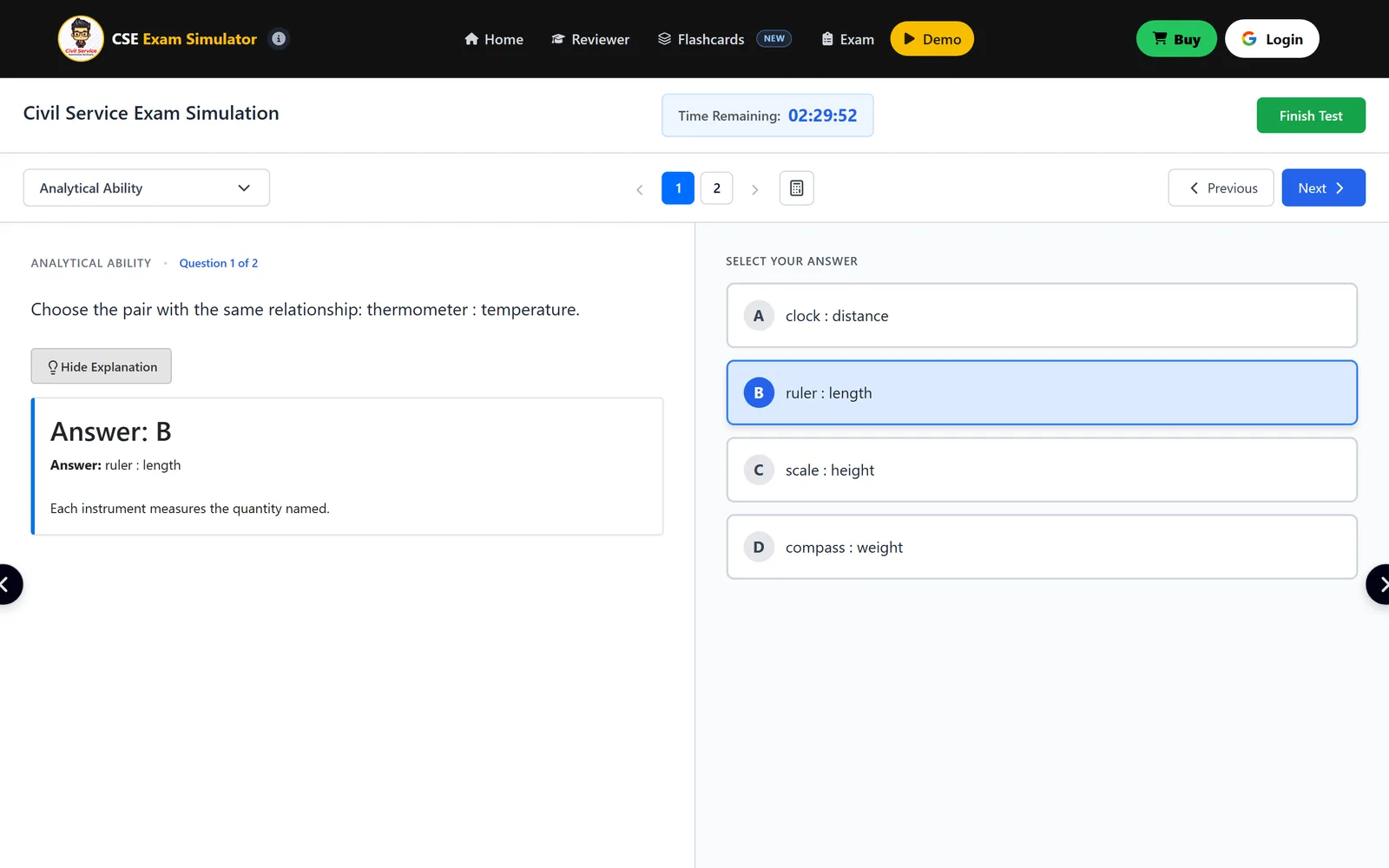
Change the method: after each paper, write one line per error. Our bank has 3,000 original practice items, 15 practice papers per level on a 2 hours 30 minutes timer, and an answer and short explanation for every item. The free demo gives you 10 items to test the fit before you decide.
For the full schedule logic, see the 10-week plan. The CSC publishes no review material and accredits no review center, so any tool you pick is your own choice. We make the simulator, so weigh our view accordingly.
Frequently asked questions
How soon can I retake the civil service exam?
You can apply for a sitting only if you did not take the same level within three months before its exam date. For the 9 August 2026 sitting, the barred window ran from 8 May to 8 August 2026. The announcement states no other waiting period. Count back three months from the date you want.
Can I retake to raise a passing rating?
No. The announcement says you may not take a level you have already passed, whether through the pen-and-paper test or other test modes. A retake is for a level you have not yet passed, so there is no way to sit the same level again for a higher rating.
Is there a limit on attempts?
The announcement we used states no limit on attempts. It states only the three-month rule and the bar on retaking a passed level. Rules can change between announcements, so read the current one for your sitting, and ask your CSC Regional or Field Office if anything is unclear.
Should I switch levels after failing?
The repeat rules apply per level, so they do not decide this for you. Choose by the positions you are aiming for, and ask the hiring agency's HR office which eligibility they need. Then confirm with the CSC that you are eligible to file for the other level. Our level comparison explains the differences.
Sources
- Examination Announcement No. 03, s. 2026: Conduct of CSE-PPT for Professional and Subprofessional Levels, 09 August 2026 — Civil Service Commission
- CSE-PPT Results August 2026 — The Summit Express (secondary)
- CSC announces March 2026 CSE-PPT results — PinoyTechSaga (secondary)
- Over 50,000 pass August 2025 career service exam — Philippine Daily Inquirer
From the publisher
Rehearse the mixed paper first.
CSE Exam Simulation is a practice simulator for the Career Service Examination, Professional and Subprofessional levels: full practice papers on a clock, with an answer and a short explanation for every item.
- 3,000 original practice items across both levels
- 15 practice papers per level, 160 items each, on a 2 hours 30 minutes timer
- An answer and a short explanation for every item
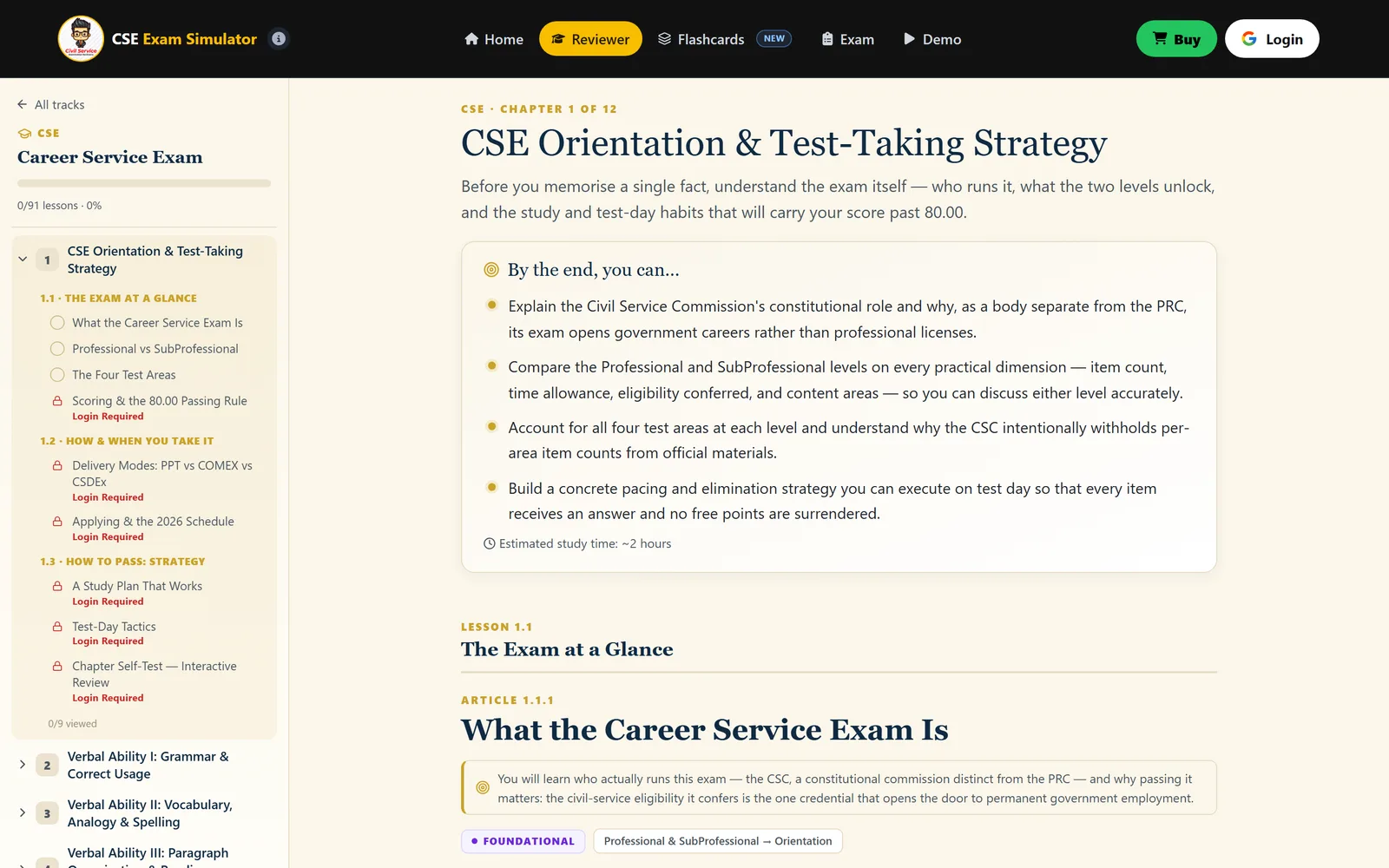
- A 12-chapter reviewer and 1,000 flashcards beside the question bank
Try the free CSE practice demo 10 practice items across all five subtests. No account needed.
About this article
Written by the editorial team that builds CSE Exam Simulation. Exam facts are checked against Civil Service Commission examination announcements and published CSC results, General Information facts against the 1987 Constitution and R.A. 6713, and every article lists its sources. How we write and check our articles.
First published .