
Guides8-minute readFor reviewees strengthening their English and Filipino
Civil service exam verbal ability: how to review English and Filipino items together
How to prepare for civil service exam verbal ability: word meaning, grammar, paragraph organization and reading comprehension, in English and Filipino.
Verbal Ability is the subtest most reviewees think they can skip studying for, because they speak English and Filipino every day. Then the grammar items arrive, and everyday fluency turns out to be a different skill from spotting the one error in four sentences. Civil service exam verbal ability rewards a method you can repeat under time pressure.
This guide takes the six topics the Civil Service Commission (CSC) lists and gives you a way to drill each one, with examples we checked. It covers English and Filipino together, because the paper mixes them. The passing rule is one general rating, so a weak Verbal result cannot be rescued by ignoring it; see what the 80.00 general rating means.
What does civil service exam verbal ability cover?
The CSC's Examination Announcement No. 03, s. 2026 lists six topics for Verbal Ability: word meaning, sentence completion, error recognition, sentence structure, paragraph organization and reading comprehension. It states that the subtest is given in English and Filipino. The other subtests are in English, and both the Professional and Subprofessional levels take Verbal Ability.
The announcement does not say how many items each topic gets, and we claim nothing about what the CSC "always" asks. Treat the table as a drill map, not a prediction.
| Topic | What the item asks | How to drill |
|---|---|---|
| Word meaning | Pick the synonym, antonym or meaning of a word or idiom | Learn words in families; guess from context first |
| Sentence completion | Choose the word that fits the blank | Find the clue word before reading the options |
| Error recognition | Find the part of a sentence that is wrong | Test agreement, tense and word choice one at a time |
| Sentence structure | Pick the clearest or correct sentence | Check parallel form, fragments and placement |
| Paragraph organization | Order scrambled sentences | Find the opener, then follow pronouns and connectors |
| Reading comprehension | Answer questions on a passage | Read the question first, then locate the evidence |
How do you review word meaning in English and Filipino?
Review word meaning by learning words in small families and always testing a guess against context. Memorising a list of single words works poorly, because an item usually asks about a word in a sentence or an idiom, and one word can carry several senses.
For English, group words by relationship: words for careful (meticulous, thorough), words for hidden (concealed, covert), words for reducing (lessen, mitigate). For each, write one sentence of your own. For Filipino, do the same with synonym pairs such as "mabilis" and "matulin", and with idioms. "Balat-sibuyas" describes a person who is easily offended. "Bukas-palad" describes a generous person. An opposite pair worth knowing is "masipag" and "tamad".
When you meet an unknown word in an item, cover the options and guess a meaning from the sentence. Then pick the option nearest your guess. The flashcard decks are a good fit for this daily, five-minute work.
How do you attack grammar items in English?
Attack English grammar items by testing one rule at a time against each underlined part, instead of rereading the sentence for a "feeling". This applies to error recognition, sentence completion and sentence structure, which share the same small set of rules.
Work through this checklist in order: subject and verb agreement, verb tense, pronoun reference, parallel form, and word choice.
- Agreement: in "The list of requirements are posted on the bulletin board", the subject is "list", so the verb should be "is".
- Parallel form: "She enjoys reading, to swim and hiking" breaks the pattern; "reading, swimming and hiking" fixes it.
- Agreement with "each": in "Each of the clerks have a desk", "each" is singular, so the verb should be "has".
For sentence completion, find the clue word first. In "The committee postponed the vote because the report was ____", the word "because" tells you the blank needs a reason, such as "incomplete". Then eliminate options that break grammar before choosing on meaning.
Which Filipino usage rules are worth drilling?
The Filipino items reward a few high-frequency rules, and the confusion between "ng" and "nang" is a classic one worth settling early. Use a question test rather than memorising a rule list.
"Ng" marks a thing or an owner and answers "ano?" (what) or "kanino?" (whose). "Bumili siya ng tinapay" means he bought bread. "Ang bahay ng kapitbahay" means the neighbour's house.
"Nang" answers "paano?" (how) or "kailan?" (when). It also joins a repeated verb. "Nag-aral siya nang mabuti" means she studied well, because "mabuti" describes how. "Umalis siya nang dumating ako" means he left when I arrived. "Tumakbo siya nang tumakbo" means he kept running.
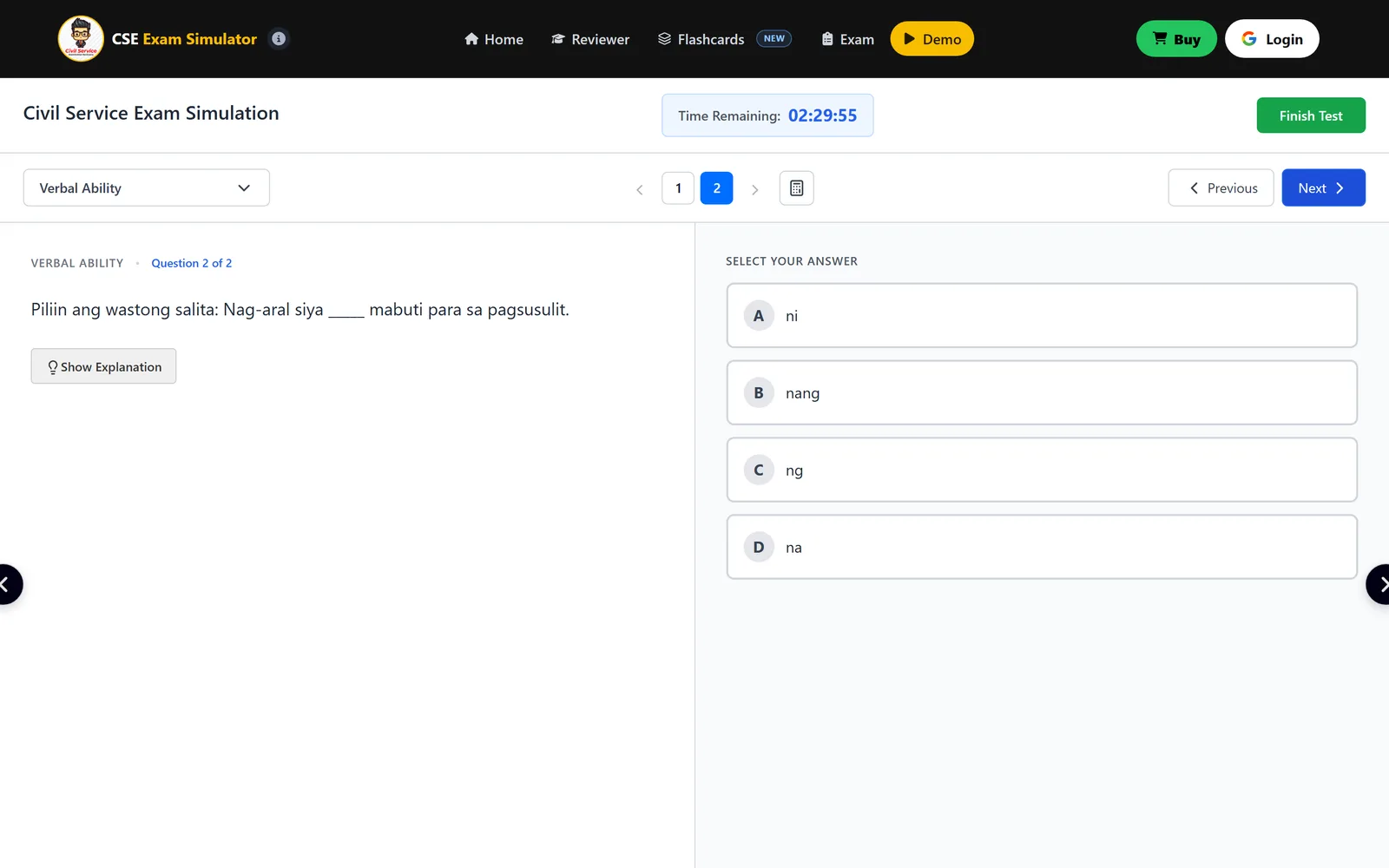
The demo item in the picture below ("Nag-aral siya ___ mabuti para sa pagsusulit") is solved by the "how" test, so the answer is "nang".
A second pair is "rin" and "din". After a word ending in a vowel, write "rin" ("Ako rin"); after a word ending in a consonant, write "din" ("Umalis din ako"). Check a Filipino grammar reference for words ending in w or y.
How do you answer paragraph organization items?
Answer paragraph organization items by finding the opening sentence first, then chaining the rest through pronouns and connectors. Reading every option from the top wastes time, because the options differ mainly in order.
Look for a sentence that introduces the subject without pronouns such as "it" or "they", since a sentence that begins with "As a result" or "However" cannot open a paragraph. Then look for chronology words (first, later, now) and cause words (so, as a result). Here is a worked example, with the sentences scrambled:
- A. As a result, the line at the counter now clears faster.
- B. The records section used to log every request by hand.
- C. Last year it moved the log to a shared spreadsheet.
- D. Staff can now see a request's status without asking.
The correct order is B, C, D, A. Sentence B opens with a full subject. Sentence C uses "it" to refer back to the section. Sentence D describes what changed, and sentence A uses "As a result" to close the chain.
Practise in Filipino too. The same logic of opener, pronoun and connector applies, with linkers such as "dahil dito" (because of this) and "samakatuwid" (therefore).
How do you read passages faster in reading comprehension items?
Read the question first, then the passage, and mark where the evidence sits before choosing an option. This order stops you from reading the passage with no purpose, which is the main reason passage items run long.
Use a three-pass habit. Pass one: read the question and its options in about ten seconds. Pass two: read the passage at normal speed, noting the main idea and the location of names, numbers and contrasts. Pass three: return to the sentence that answers the question and match it to an option.
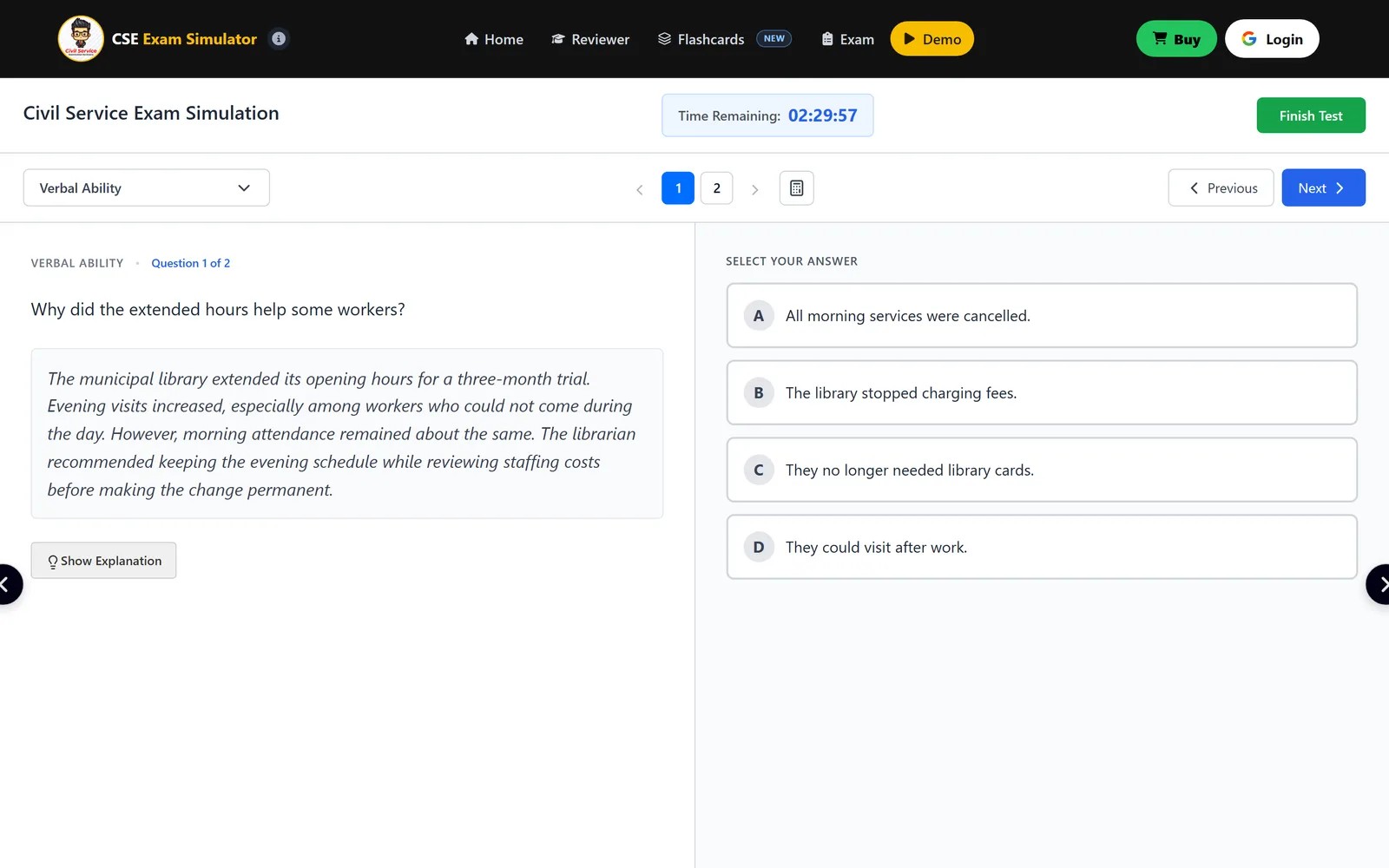
Beware of options that are true in general but not stated in the passage. An answer must come from the text, not from your own knowledge. The library passage in the demo room is a good place to practise: ask what the passage says about the reason the extended hours helped, and find the sentence before looking at the options.
Passage items take longer than word-meaning items, so plan for it. The time management guide shows how to bank seconds on quick items and spend them here.
What does a two-week Verbal block look like?
A two-week Verbal block gives each topic two focused days and ends with a mixed set. Adjust the days to your weaker language, and run the block inside the larger 10-week plan.
| Day | Focus | Task |
|---|---|---|
| 1 | Word meaning, English | Ten words in families; one sentence each |
| 2 | Word meaning, Filipino | Synonyms, opposites and five idioms |
| 3 | Error recognition, English | Agreement, tense, pronouns; log misses |
| 4 | Error recognition, Filipino | ng and nang, rin and din; log misses |
| 5 | Sentence structure | Parallel form, fragments, clear placement |
| 6 | Sentence completion | Clue-word drill in both languages |
| 7 | Rest or flashcards | Light review only |
| 8-9 | Paragraph organization | Opener, pronoun and connector chains |
| 10-11 | Reading comprehension | Question first; mark the evidence |
| 12 | Mixed Verbal set | Time yourself |
| 13 | Repair | Redo every miss from your log |
| 14 | Rest | Light flashcards only |
In CSE Exam Simulation, the Verbal Ability items mix English and Filipino, and each explanation is written in the language of the item. The free demo has 10 items across all five subtests, so you can try a Verbal item and read its explanation before committing to a plan.
Frequently asked questions
Are there Filipino questions in the civil service exam?
Yes. The CSC's announcement states that Verbal Ability is given in English and Filipino, and that the other subtests are in English. There is no separate Filipino subtest; the Filipino items sit inside Verbal Ability, so review both languages for that one subtest.
How do I read passages faster without missing details?
Read the question and options first, then read the passage once while marking names, numbers and contrasts. Return only to the sentence that answers the question. Speed comes from reading with a purpose, not from skimming faster, and practising on timed sets builds it.
Is spelling part of Verbal Ability?
No. The CSC announcement lists spelling under Clerical Ability, which is given at the Subprofessional level. Verbal Ability's listed topics are word meaning, sentence completion, error recognition, sentence structure, paragraph organization and reading comprehension. See the Analytical and Clerical guide for spelling.
Sources
- Examination Announcement No. 03, s. 2026: Conduct of CSE-PPT for Professional and Subprofessional Levels — Civil Service Commission
- How to apply for August 2026 Career Service Examination-Pen and Paper Test — GMA News
- CSC releases 2026 civil service exam schedule and application timelines — Daily Tribune
From the publisher
Rehearse the mixed paper first.
CSE Exam Simulation is a practice simulator for the Career Service Examination, Professional and Subprofessional levels: full practice papers on a clock, with an answer and a short explanation for every item.
- 3,000 original practice items across both levels
- 15 practice papers per level, 160 items each, on a 2 hours 30 minutes timer
- An answer and a short explanation for every item
- A 12-chapter reviewer and 1,000 flashcards beside the question bank
Try the free CSE practice demo 10 practice items across all five subtests. No account needed.
About this article
Written by the editorial team that builds CSE Exam Simulation. Exam facts are checked against Civil Service Commission examination announcements and published CSC results, General Information facts against the 1987 Constitution and R.A. 6713, and every article lists its sources. How we write and check our articles.
First published .